Wednesday, 22 August 2018
I have to start this by saying that, in Ghana, home is expensive. A cheap acoustic guitar in the United States will run you about $75 minimum, and the price is about the same here. But in Ghana everyone makes less money. So if you buy something that’s not from here, whoa, it’s gonna be expensive. That guitar is half of my monthly pay. I really have to budget and splurge for that guitar.
The same is true for coffee.
I actually don’t know how much coffee is here, because I haven’t been able to find it. The closest thing I’ve found is this dehydrated just-add-water powder called Nescafé. If you’ve ever had the Starbucks equivalent (Starbucks Via?), stop, no, you don’t understand. This is not as good as that awful stuff. Take that Via packet, replace the contents with topsoil and loathing, and now you’re getting close. In the United States, I turn up my nose to Starbucks. I don’t drink Nescafé.
That’s why it was so special that I was sitting in a tiny rural town in the Northern Region with a French press and three pounds of coffee grounds. It was out of place and bewildering, like blue jeans on Shakespeare, and yet here were all my supplies for the amazing thing I was about to do – coffee grounds, press, spoon, cup, water heater.
For those from my generation, when someone says “water heater”, lots of things probably come up. Coffee pot, microwave, saucepan and stove, heck maybe even a crock pot. But for older folks and for Ghanaians, it’s this thing.
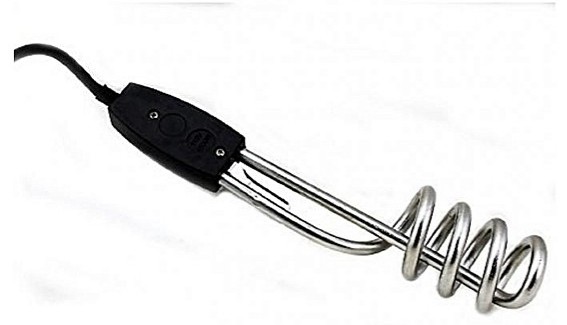
Photo courtesy of http://www.jumia.co.ke
No, that’s not a shiny fluorescent light bulb, it’s a water heater. “For tea,” as one man in the market told me (the Brits left 60 years ago y’all, make a Boston party with that tea). After looking at it for a little while, I had the idea. Electricity enters the handle piece, activates a heating element, the heat travels to the metal coil and into the water. Easy. The man in the market also warned, “Do not plug it into a power strip. Plug it to the source. This will burn the power strip.” Pulls a lot of amps, got it.
I filled the cup with clear, fresh rainwater from the night before. “I do bless the rains down in Africa,” I thought. Setting the cup to the side, I picked up the water heater by the small rubber handle, being careful not to touch the metal which might get hot very fast, plugged it into the wall, and experimentally flipped the switch on the wall which closed the circuit to the power grid. It was amazing, that I could heat water so quickly and easily – without having to make a fire or anything – almost as amazing as the 240 volts which had just laid down a superhighway in my nervous system.
Two things here. First, yes, it’s 240 volts. In the United States we typically have 120 volts in our wall plugs. But a lot of countries, apparently sensitive that they didn’t invent electricity, saw that number and said, “We could probably double that.” Ghana is one of those countries. If you’re not an electrician, I’ll just say that sticking a fork in the socket back home hurts only half as much as what I was doing at this moment. Second, I was wrong about the design of the water heater. Turns out there’s no heating element. It’s just pure, natural, old-fashioned electric current running through those metal coils and, as it turns out, passing very easily through the thin rubber “handle”. If this strikes you as dangerous, you have good instincts. It is very dangerous. Any toddler could get a really nasty shock from a water heater really easily.
This toddler was afraid. There was a buzzing in my head – was it hundreds of horseflies or just the rattling of my jaw against my skull? – and a strange urgent clenching pain shooting from my arm to my heels and back again, and an overwhelming heartbreaking certainty that I was dying. “Not like this, not so far from home, not right before coffee,” I would have wailed if I could have opened my mouth. I was sure my facial expression – and soon-to-be death mask – looked unspeakably stupid, too.
Between electrons, I assessed the situation. The hand holding the death device would not open, that much was sure. Anyone who’s been electrocuted can support me on this. The only other thing I could do was flip the wall switch back to OFF. A wave of dismay swept over me as I began moving my still-pointing finger a quarter inch down. It was too far, it was too much, I didn’t have the strength to move with these current shackles. But thinking about my home, the people I love, and coffee, I summoned the greatest burst of strength I could and finally, finally killed the circuit.
Later, a friend in my community would ask if I was barefoot at the time. I said I was. “Ah!” he laughed. “Yes, shoes would have helped some.” Remember, kids, always wear shoes when you make coffee.
Soon after the lingering pain had died down and I had triple-checked on my Last Will and Testament, the water heater was in the corner opposite the wall plug and I was slowly bringing that clear, fresh rainwater to a boil in a saucepan. Straddled on a wooden bench on the shared porch of my compound, I was entirely focused on the sublime sight and smell of spooning coffee grounds into the French press. These wonderfully dark, earthy, wooden, oily grains – had they really come all the way here from all the way home, and before that from who knows where? This press – its fine mesh, its shiny metal parts, its snugly fitting lid, its spotless glass body – had it really survived three months in a suitcase perfectly preserved, ready to use, unbroken (sadly, at the time of this writing, it has in fact shattered in an incident which is still too fresh for me to talk much about)?
With growing rapture I poured a heaping spoonful of that roasted heavenly aroma into the bottom of the press. Was it too much? Yes. That’s okay. The water, it’s boiling now, quick, take it off the heat. Now with the cup, fill the press with water almost to the top – more – more – almost – yes! Now, the lid and plunger on top, and set it all down. No, not on the bench, not so high, put it on the floor. Yes, there, out of the way of foot traffic.
As the grounds tumbled and swirled in the darkening water, I suddenly realized how close it was. That right there, that dark brew just a few feet away from me, that is coffee. It’s weak now, but it’s real coffee all the same, and it’s getting stronger and better, just like me after that encounter with the one-dollar Tesla coil.
Time crawled by. Two minutes, three minutes, four years – I don’t know how long I’d waited but finally I decided it was long enough. I rushed to my knees and then, gingerly and deferentially, set the press on the bench next to the empty cup. The plunger came down with such beauty, such precision. Not a single coffee ground made it through to the top of the chamber and yet the coffee – for now it definitely was coffee – surged up through the layer of collecting grounds, picking up just one more shade of darkness, resolving magnificently with an earthy blackness. Here I was patient with the press, watching its grand finale, its pièce de résistance. Finally, with a short tok, the plunger reached the bottom. It was ready.
After an interval of respectful silence, I seized the press and tipped it over the cup. Falling in a single black stream, the coffee first struck the bottom of the cup – bubbling, frothing – then as the level rose it moved from a jumping tumult to a sloshing whirling vortex to a hurried current, and reaching the brim, it mellowed to a ponderous spin. The brown-bordered bubbles on the surface looked about and, feeling out of place, burst out of sight.
My hand, damp with steam, reached for the cup and I brought it to my nose. I exhaled, then closing my eyes, inhaled deeply. The full aroma flowed upwards into my sinuses, my lungs, my whole body. It billowed in eddies in my brain; it churned in long-sleeping pieces of my memory. I tipped it back towards my lips.
How can I describe the taste of it? It tasted like those rare weekend mornings when Mom and Dad let us kids have a small mug of it mixed evenly with milk. It tasted like walking through campus at midnight, a headphone in one ear, mind buzzing with all the studying I haven’t started yet, the warmth of the thermos in my hand mingling perfectly with a cool fall breeze. It tasted like that coffee shop I found in Cedar Rapids, with the killer lattes and china cups and a real fireplace and live music and dark wood on every surface. It tasted like Christmas morning, aromas seeping from the grinder downstairs to the gap under my door and to my bed, holiday music accompanying Dad’s whistling. It tasted like home.
From the spire of the nearby community mosque, an afternoon call to prayer floated on the air, over my head to the mud-walled homes and farmlands beyond. I drank deep of the coffee and of the savanna, of my home and of my community. How lucky I am, to be here living and serving, to wake up in the morning with good things to do and to go to bed having done them, to be in every moment a teacher and a learner. I sighed and slouched contentedly.
Soon the cup was empty, my tongue was scalded and rubbery, and the rest of me was sweaty. I looked over at the press, which had a small concentrated bit of liquid in the bottom. Without a thought I drank that too, straight from the spout.
I glanced behind me at the coals, which were glowing red and totally capable of boiling more water, then back at the bag of grounds. Really, it would be a shame to waste the heat.

 Tim in Ghana: A Look into the Life of a Peace Corps Volunteer
Awful glad that’s not the first time I’ve heard your electrocution story. Scares the hell outta me.
I make a point every morning to wake up earlier than necessary, specifically so I can have a moment with just me and my coffee. My peers think I’m crazy to lose sleep when I can just as easily grab a cup to go, but I always tell them that coffee is meant to be an event, not a quick fix. Your coffee situation sounds like a lot more of an ‘event’ than mine, but it pleases me that we share the pleasure of the moment.
Continue all of your teachings and learnings, and please continue all of your writings as through them, you are teaching the rest of us as well.
LikeLike
Thankfully, I’d heard it before too but I’m still terrified every time I think of it!! Tim, I forgot about that coffee shop in Cedar Rapids – BEST cappuccino indeed! Love, love, love your coffee appreciation 😘
LikeLike
Ahh, what you are holding back is the sad and defeating event that cost you the use of your french press. Two more months and then the coffee is yours to brew again! What is Tim going to be more excited about, me, or all of the goodies that my visit entails?
LikeLike
I’m admiring your choice of “tok”. That is exactly what if feels and sounds like at the end of the press. Lovely.
I’m sorry you were electrocuted, but it made some searing irony. I guess art does come from pain?
LikeLike
Ther must be an Aggie joke in there somewhere. Very happy that you’re ok and even happier that you have such a gift in your ability to animate the experience in our imaginations by your telling of it. Be well.
LikeLike