Tuesday, 19 June 2018
Obruni is a local Ghanaian word for which the simplest, most direct translation is “foreigner”. But really, it is a word that means as little or as much as you think it means. For instance, it was first used to refer to the Portuguese explorers that initially set foot in this region of West Africa in the 15th century. Then it simply meant “white man” (that was a notable feature for the native dark-skinned peoples living here), and to some people that’s what it still means today. Or it could mean much more than “white man”. It refers to women. It refers to people of South Asian and East Asian descent. In fact, it refers to anyone at all who doesn’t have dark skin. And if a dark-skinned person turns out to be African American, as some of my fellow PCTs are, they will probably be called obruni too. Yet a native-born light-skinned Ghanaian will probably be called obruni all their life. So what does it mean, really?
On a typical day in my host community (Peace Corps asks that we don’t mention the name of the town), I wake up around 5:30 or 6:00. I lay in bed for a while and consider going on a run, but by the time I’m outside the mosquito net and tucking it back in under the mattress, I’ve usually found a reason why I shouldn’t today. I fumble around the room for clothes and shower supplies, unlock the door to the sitting area, and make my way across the small yard to the latrine and shower area.
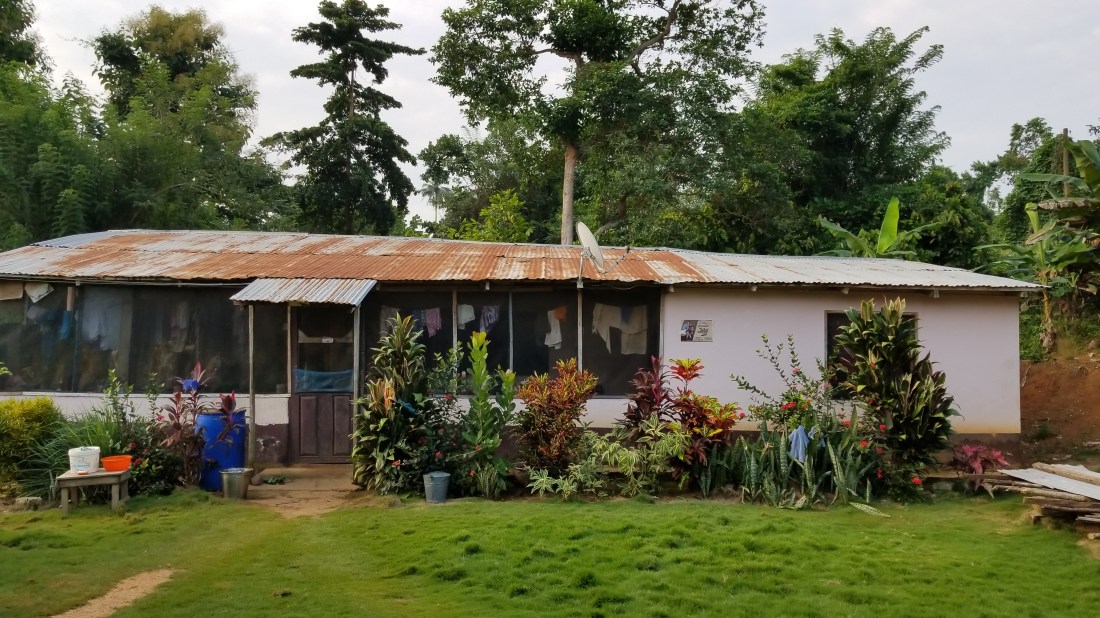
The house itself has a narrow sitting area which functions as a screened porch, and three similar-sized bedrooms – one for me, one for my host parents, and one for the other six or twelve people who live here (depending on how many visit for the weekend). It has electricity but no plumbing. Water is hand-carried in from various pumps in town, or it comes from the sky. The kitchen area is a short walk down the hill from the main house, and consists of a cinder-block-and-wood enclosure with a couple of fireplaces on the ground surrounded by cooking supplies and equipment. Compared to the rest of the town, I would guess my host family is upper middle class.
It’s dark and dense in the latrine, and if you try to entertain yourself with Sudoku on your phone, the flies will focus their wild buzzing on your lit-up head and face instead of on the entrance to their home (a home whose threshold you are blocking). The sweat dripping from your nose and eyebrows isn’t so bad when you open the door to the outside and it cools all at once, and I must say the air immediately next to a latrine never smells sweeter than in the moment you exit the latrine. In the shower, the first bucket of water you pour over your head is always the coldest, so I usually get it over with immediately. All in all, I’ve got my whole bathing routine down to about a gallon and a half of water, which is weird to my host family but will be a helpful skill if I’m sent to an especially dry region.
By the time I get back to the house, my host mom has usually brought my breakfast to me on a tray, covered with a lace doily. She’s figured out I like eggs and oats, so that’s all she serves in the mornings. I eat alone because the rest of the family is eating in the kitchen, doing chores, or cooking (and they get uncomfortable when I invade the kitchen) except for my host dad, who also likes to eat alone in his room. Don’t get me started on Ghanaian eating customs. I’m still trying to figure it out.
Then I usually do some cleaning and organizing myself, including prepping for the lessons I’ll be receiving and giving today. Dress is always business casual because of my high status as a teacher (and because of high wardrobe standards here in Ghana), and with a nice film of sweat already forming on my arms and face, I’m off to training.
Walking past the schoolhouses I hear excited cries of hey, hey, hey and obruni, obruuuuniii! On the paths and roads through the town, sometimes peeking shyly from windows and doors and sometimes standing firmly in the road, small children glance and stare at my strange skin, my soft hair, my blue eyes. I smile, wave, and greet them in as much of their language as I’ve learned so far, but more often than not they return my poor Twi with silence. I’ve found high fives are a language we all understand, though. Adults in town, sometimes charmed by my attempts at language and sometimes exasperated with another foreigner smiling and waving, generally exchange at most a few lines of standard greeting and move on.
After four hours of language and technical (teaching) training, I return to my host house for long enough to peel off my hot clothes, sit down and eat, switch out my books and notes, put my hot clothes back on, and head back out for four more hours of learning. My host mom always has my lunch ready for me, and let’s just say that within the first nanosecond of looking at it I can guess how many Tums I’ll be taking today. Chicken and rice? One maybe. Banku and fish? Bring the bottle. Maybe I should ask her to dial it back on the banku.
In the evening I might do some shopping for necessities, but I’m almost always back at the house by 18:00. By the time I’ve visited the latrine, showered, and changed into cooler clothes that still cover lots of skin (bugs, as my leopard-print skin can tell you, are the worst in this region), my host mom has served up another lovingly prepared mystery meal. I try to eat it quickly so I’ll have time to scout around town for a decent cell signal to call home (usually Colleen) before it gets too dark.
One way or another I’m always back in the house before 20:00, which gives me enough time to interact with my host family some more and help my host brothers (ages 7 and 9) with their homework. I’m usually in bed by 21:00.
Around this time of day last week, my host dad was playing gospel music on the radio as he almost always does, but I was in the mood for my own tunes. I asked him if it would be okay for me to play a few songs, and he agreed with a “Yes, yes!”. Now, I don’t know how many of y’all like old country, but I have a playlist of music that my late grandpa loved to listen to, and I love it too. I’m talking Conway, Patsy Cline, the Hag, Jean Shepard, Faron Young, Ferlin Husky – all those good old songs. Well, I started shuffling from that playlist, and from the first few notes my host dad’s eyes just lit up. He started asking about the music and the words, and commenting on the ease and deepness of the notes and rhythms. When I told him it was music from when he was young, and in my home region we still like to listen to it, and especially when I told him it helps me remember my grandfather, he smiled and nodded along with the shuffle beat. Turns out that even an old Ghanaian prince (did I mention he’s a prince?) can appreciate a good old country song.
I was chatting brokenly with him the second night I was here, and he was talking about how, in his opinion, the Ghanaian people weren’t being well provided for by the government. Then he paused, and with sadness and matter-of-factness in his eyes, he said to me, “The people of Ghana do not have the good things Americans have.” I was stunned. I tried to come up with some kind of caveat, some way to encourage him and show him that Ghana has wonderful things in it and that I’m already seeing them. I said, “People in the United States, they are not happy. They do not smile as much as Ghanaians. Maybe they have big houses, but many are still unhappy. Here you laugh-” But he cut me off with a shake of his head. “For the black man, everything is black. For the white man, everything is white.”
The Peace Corps training staff and other Ghanaians who have come to know us well insist that obruni is not a derogatory term. “The children don’t know not to shout it at you.” “If you tell them your name, they will not call you obruni.” “It really just means ‘foreigner’.” It’s all true. And as a privileged minority in Ghana, I really don’t mind if obruni is my identifier – because, well, like I said, it’s true.
At the beginning of this post, I said that obruni could mean a little or a lot. For me, there’s no mistaking what it means. It’s the mosquito net I need and expect. It’s the lock on my bedroom door. It’s the latrine which has in fact been fixed up comparatively nicely for me. It’s the room I have all to myself. It’s the training my host mom had to receive to cook food for my unseasoned stomach, and it’s the cramps and Tums I don’t go anywhere without. It’s the nice American clothes and the sweat shining on my bug-bitten skin. It’s the calls of schoolchildren hopping from behind windows. It’s the giggles and laughs when I squat low and offer high fives. It’s the genuine appreciation from people around town when I attempt some Twi, and it’s the mild offense taken when I forget to greet someone I pass on the street. It’s the pride my host brothers display when I greet them in front of their friends. It’s the excitement my host dad and I feel as we share our music with each other. Put simply, it’s the details of my life here that are just as new and strange to me as they are to the people of this town.
More than that, though, obruni is the moment I realize that my host brothers, after a long day of school and chores, can’t do their homework assignment because they weren’t taught how to use a dictionary. It’s the “no” in their eyes when I ask if they understand a math problem even though their mouths say “yes”. And it’s the response I wish I’d given to my host dad – to somehow tell him that he’s right but I wish he was wrong, and if everyone agreed that he was wrong then maybe it would be true.
Obruni is why I’m here. I could ignore it and just live in this country for two years as a math teacher and then go home, but then why go to all the trouble and leave the people and the air conditioning I love so far behind? No, I’m here to share and learn, take and teach. After my time here I want to be able to show my friends and family the different lives of people far away, such foreign foreigners and yet such human people. And I want to have brought at least a few people here just a little bit closer to their own self-achievement – to give the brush to young minds who know they can paint their country any color they want.

 Tim in Ghana: A Look into the Life of a Peace Corps Volunteer
Oh Tim, I laughed out loud and then cried when I read the part about Grandpa’s music! It’s surreal to me that you shared some of your Grandpa with a Ghanaian Prince. How perfectly fitting and beautiful. I thoroughly love this piece. In the end, we are all human. But, those who take and share, teach and learn will do a better job of being human than ever before. Love always.
Mom
LikeLike
“And it’s the response I wish I’d given to my host dad – to somehow tell him that he’s right but I wish he was wrong, and if everyone agreed that he was wrong then maybe it would be true.” I loved this reflection. This is primarily how I’ve learned to be better at talking with my kids about race and prejudice and shameful truths: By saying the wrong thing but doing it better the next time.
LikeLike
I’m with Kim on this one. I have no idea what I would have said in that moment. I have been ruminating a lot lately on the inequality of resources and subsequent security and comfort, and reading all of your posts is bringing those thoughts back to the forefront. Come back enlightened, bro. I could use some wisdom myself.
LikeLike
Tim, I am amused and saddened all at the same time. What an adventure but also an unreal and , to say the least, uncomfortable experience. I am in awe of your decision to do this, to give up so much and endure so much for the good of the children so that they might have a better future. God bless you my precious grandson. Proud is an understatement. I’m also impressed by your ability to express yourself. It should be a book for all to enjoy as I have. Love, Gramsie.
LikeLike