Leaving

Mandiaya

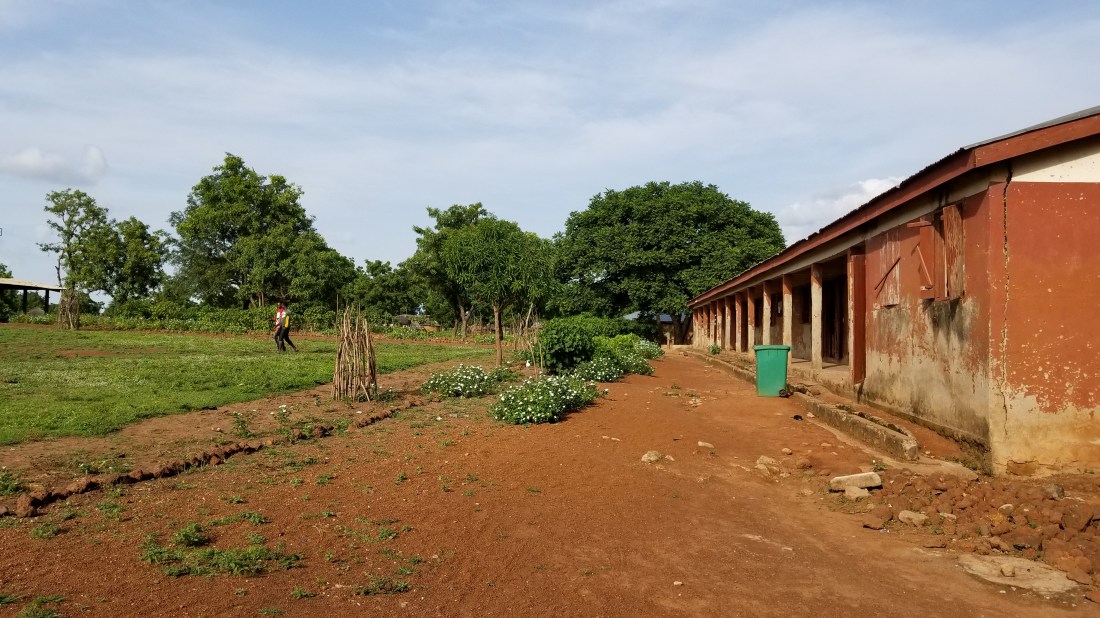
It’s Friday morning, first period. We sit idly on and among broken rows of desks, humming with low scattered sentences. The emptiness at the front of the classroom is heavy. My gaze wanders from the empty blackboard to the open window, and I stare out at the assembly ground.

Stones, some the size of my fist and some the size of my head, radiate in lines from the cleared central rise. It’s just enough of a hill that you can see the tops of everyone’s heads as you address them, your heart thrumming in your chest, your hands clasped together to stop them from shaking.

Mandiaya stood there last week, his heart thrumming, his hands clasped, his voice skipping, tripping, falling.

I turned away when I realized what he was saying. I wanted to hide my face from my friends. I wanted to hide his face from me. I wanted him to just come into the classroom and teach already, like he always did, and walk among the rows and look at my work and say, “Good job!” or “Very close! Maybe try…”

When he finally ended his speech and walked to the roadside, a lot of the class followed him. I just stood watching him leave, rooted to the spot, to grow like a tree, a monument, to the place where he should return. Here is your school! Here are your students! Come back!

The teachers say he will come back. But his face, before I hid behind the other assembled students, said he wouldn’t.

Ukanja

I tried to call him today. Timoti, the ukanja, the white man who came to our school last year and then left during the tribal fighting, saying he wanted to come back, saying he would come back – he didn’t pick up the phone. It didn’t even ring.

He never did visit back, even though he told me that he was still in Ghana, that he was planning to return. A new school and a new set of students, and no time for us. And now he’s gone home.

Or maybe his phone broke. Or he got a new number. I remember when he changed his number some time ago, and I had to wait for him to call me.

I don’t want to wait for that. Maybe I’ll try calling again.

Tim

I wake up to my phone vibrating on the bedside table. Squinting, I wait for my eyes to adjust to the brilliantly glowing screen. Messages, buzzing in from a group chat in quick succession. Someone can’t sleep.

I put the phone down. Pick it back up. Three in the morning.

The room is calm and quiet. In the still darkness, a cool whisper of air rolls easily over my thick blanket. The pillow under my head is soft. The mattress is firm with just enough give.

The bed frame is a dark brown carved wood, a match to the desk and drawers along the wall. A closet full of clothes and shoes and board games lies behind doors just out of reach. If I’m thirsty, an infinity of water glasses is just twenty steps away. And if I drink too many, the toilet is just two steps farther on.

The lights can turn on and never go out. The pantry and man-sized fridge are full. The roads are black, the yards are lush, the sidewalks are wide and clean.

It’s home, like a strange guilty memory, a dream so real I can touch it, just before waking up in a hot loud dusty itchy night.

I remember that I forgot to call Immanuel, to explain, to give him my American number. To apologize.

Esther

I shift the faded textbook to my left hand and look down at my right. Spreading from the fingertips to the palm is a powdery grayness. Black from the blackboard, white from the chalk. Somewhere a battered alarm bell rings weakly at the thought of broken battery guts – made into a paste, spread on the board in a fresh new darkness, coming off on my hands – but, blinking, I allow it to fade.

With the weight of hazy sunlight on my head, I cross the schoolyard to the shade of the shea tree, set my book on a crowded old wooden table, and sigh into a chair. “The form three students are noisy today,” I remark across the table to Esther.

“Ehn, even since morning assembly,” she agrees softly, raising her eyebrows. She glances down at Nafisa, who is nursing in her arms. Her face is impatient but kind, as if she’s grinding her teeth against a spreading smile. Despite her age, her brow is already showing lines of understanding. Her eyes reveal a hidden firmness. “Nafi, you weren’t hungry this morning, but now that I have class you won’t let go.”

I smile, leaning to the side to wash my hands with water from a sachet. Reluctantly the black smudges follow the white chalk dust in a trickle to the ground. The rest comes off in a graying handkerchief.

Esther looks up at me. “Did you hear the Ashanti Regional Minister’s speech?”

“No, I didn’t,” I answer. “What did he say?”

“He was talking about these killings in Ashanti Region as if they were not a problem. It is a problem, sir! Your people are being killed and it’s not a problem?”

“Maybe he’s thinking about the election this year.”

“Ehn, maybe. He said that some of them were ‘even prostitutes’. Even prostitutes! So is it not a crime if they are prostitutes?” Esther, conscious of Nafisa, gestured as well as she could with her chin and feet.

“Psh,” I shake my head. “It’s always a crime.”

A thin, long-armed student approaches the table with a persistent slight bow. “Madam,” he mouths softly.

Esther turns her head powerfully on him. “Is it class time?”

He nods, already backpedalling.

She looks at me then down at Nafisa, whose hand has begun a slow journey to her own chest in a drowzy plunge. “I worry about them sometimes,” Esther remarks in a low voice. Gingerly she gathers Nafisa in one arm, and with her free hand works her breast back into her dress.

“You worry about your students?” I ask.

Still in the chair, Esther is bent sideways to the ground, setting Nafisa on a mat. “Nafi-Nafi,” she coos. Nafisa squirms and smacks in her sleep.

Esther sits up. “All of Ghana’s students,” she answers, still looking at her daughter. “We have so many problems – our politicians, our money – but the politicians and the money will never fix it. Our students will be the ones to fix the problems, but maybe they will do it wrong.”

“How would they do it wrong?”

She stands up and gathers her teaching supplies, squinting across the schoolyard into dry farmland. “I don’t know. But my father doesn’t like the changes I want to make, so I believe I won’t like the changes they will make.”

“Hmm. In my place we say that the next generation will always be better than the current one.”

Esther shrugs. “But we are changing faster than you.”

Khalid

Today the weather wins. Shaking our heads at the hot sandy air, Khalid and I move worn plastic chairs into a stagnant featureless room at the end of the school block. We settle down, sighing, raising our eyebrows at each other: “Can you believe this weather?” On the blank wall a dirt-caked glass jalousie window glows with yellow-brown light. The smell of bats and mice sits heavy in corners and cobwebbed ceiling tiles.

When he’s not paying attention to himself, Khalid often falls into a modern philosopher’s pose. His elbow drives into the chair’s armrest, his fist nearly stifles his mouth and nose, his head perches crookedly with a brow drawn low. His eyes, large and dark, stare habitually into his lap at a phone that may be on or off.

“Excuse,” mumbles a uniformed student as she enters the room meekly. Despite her soft tone, Khalid starts in his chair as the spell of his reverie is broken.

“Mm-hmm, yes, enter,” he nods, gesturing sideways at the table against the wall. The student approaches the table, sets down a small shapeless plastic bag, and trots out of the room without another word.

Dragging his chair to the table, he invites me to share the food with him. “Today we have fried yam for lunch. Join me.”

“Oh, no thank you, I am not hungry,” I smile. “Did the student bring them from town?”

Not shy about talking through the steaming yam in his mouth, he answers, “Mm. Mm-hmm, today I saw a woman by the roadside selling them.” He gestures at the bag. “Only four cedis.”

I raise my eyebrows and make a “nice deal” face.

Khalid is young, the same age as me, with only a few years on the admittedly old junior high school students we teach. When the more senior teachers gather and talk politics, he pulls up a chair and sits as far into the circle as he can. Knowing he’ll never get a word in, he listens with a serious face – nodding, shaking his head, clicking his tongue, learning.

Swallowing the mouthful of food, he remarks, “I’ve heard there is a man in Accra who will sit in a room among friends just as we are. But before he leaves the room, he gives ten thousand cedis to everyone else in the room.”

“Ten thousand?!”

Khalid nods. “He is a very rich man. A politician.”

“Is that the only way to get rich in Ghana?” I laugh. “Being a politician?”

“It is the easiest way,” he says, not matching my joking tone. “But maybe not the best way. Our own Vice President became rich that way.”

For a few minutes the room is silent except for the enthusiastic sounds of Khalid’s meal. Thinking the conversation is over, I go back to my book. Khalid finishes the last of the pieces of fried yam then walks to the door, leans out, and rinses his hands with a water sachet. He returns to his chair and frowns at me.

“I don’t like our corruption. Politicians shouldn’t get rich. It should cost money to be in politics. Then only the right people would be in government.”

I close my book. “Absolutely. Then they would run for office for the right reasons.”

“But first we have to vote these people out.” Khalid sighs and fixes his eyes on a spot on the wall behind me. “Maybe you know that the Vice President is a Mamprusi man. So now everyone is saying that we have to vote for the ruling party. They say, ‘Don’t hate your tribal brother.’ Ah! I don’t hate him. Anyway, maybe he’s wrong.”

“So all Mamprusis have to vote for his party, just because he’s a Mamprusi?” I ask.

“That’s Ghana,” Khalid laughs humorlessly. He gestures at me with two hands. “Do you have tribes in America?”

“Yes, but they are not like the tribes in Ghana. And I am not a part of one.”

“But you have your people.”

I think a moment. “Yeah, I guess.”

“Do you vote with your people?”

Isaac

A hot breeze full of sand surges across the noisy schoolyard and into our eyes and mouths as we wince in the shade of a shea tree. Tiny white flowers, caught in the tumult, find their ways under our collars and up our trouser legs, their broken stems building along hems like drifts of prickly frustration.

“Gah!” Isaac protests, shielding his face and neck with an old soft handkerchief. With a grunt he raises himself halfway out of the cracked plastic chair, sets its back to the wind, then lightly settles back down.

We sit side by side and share a friendly groan.

He has a small face, as if his brows and nose and mouth are all pressed together, despite the wide smile he seems to always wear. His laugh lines, rather than pointing to his approaching middle age, seem like something he’s always had. And his eyes, the youngest part of him, sparkle continuously with a boyish energy. He looks over his shoulder at me.

“Do you have this weather in your place?” Isaac asks, gesturing at the dust blowing around us.

“Hmm,” I think a moment. “Yes, but not in my part of the country. Some places, though, get very dusty like Ghana.”

His eyes wander to some point in the distance. “Mm. America. One day I will follow you there.” He glances at me and raises his eyebrows.

“Oh? Do you have a plane ticket?” I play along.

“Not yet, but I will become a politician. Then I will be rich, and I will come visit you.”

“Good! When you come, bring groundnut soup and shea butter.”

Before the words are out of my mouth, he’s laughing and jostling my hand, and I’m raising my eyebrows at him in a mock challenge. Just as he’s starting to respond, the breeze picks up again, and we grimace under hunched shoulders. After a few moments he begins humming good-naturedly.

A group of kids play a clapping game nearby, their shouts echoing off of sandy school walls.

Cutting himself off, he adds, “But, you know, it’s possible. Our Vice President is a Mamprusi man, from my tribe. His children don’t know this place, but he does.” Thinking for a moment, he remarks, “I’m sure his children attend a private school in Accra.”

I nod. “He won’t put them in public schools?”

Isaac clicks his tongue. “Oh, no, no. Look around. Would you send your children here?”

Satisfied with his point, he raises his phone into view and starts playing a game that looks a lot like Candy Crush. Sounds of fanfare, oohs and aahs, and cartoon explosions spill out of his hand. His face is a pensive mask. After a few minutes, he closes the game and lowers his hand to his lap, still humming the background song.

“Corruption. We have such problems with corruption.” He sighs and squints his eyes at a small stone next to his foot. “We need to elect someone who will put all of the corrupt ones in jail. Maybe a military man who’s not afraid to use the army and the police. That’s why I like your President. He likes to fight. Our own President, he made so many promises. ‘Teachers are suffering. Nurses are suffering.’ So I voted for him. That was three years ago, and the teachers and nurses are still suffering. Too many promises. Meanwhile he is getting rich. Very rich. So next time I won’t vote.”

“Why not?” I ask.

“It won’t matter,” he makes a helpless gesture. “They will always make promises. They will always be corrupt. For us Africans, it’s in our nature. It’s in the black skin. That’s why we need a powerful man, not democracy.”

“Wait – what – no -” I’m confused. “How do you know what Africa needs?”

Isaac grins. “How do you?”

Silminga

20191126_171921.jpg

I saw the silminga today.

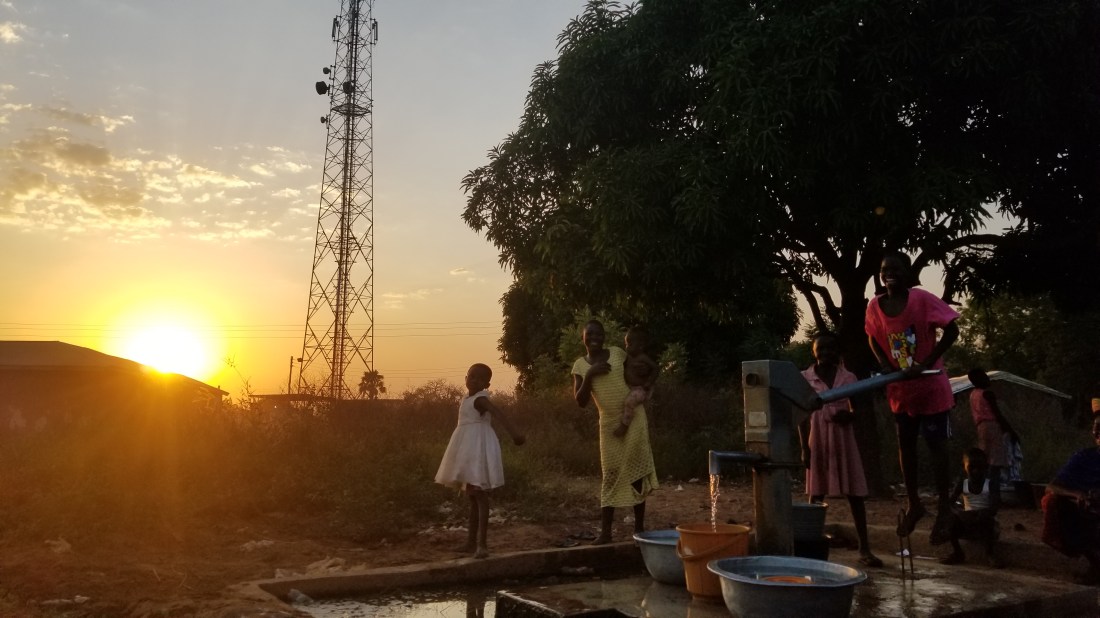
I was at the borehole with Adam and Esther, fetching water for Madam Rose, when I suddenly saw him approaching us with his bicycle and jerry can. He was wearing house clothes, like my father after he comes back from farm. He smiled at us and greeted us. Then he removed the jerry can from the bicycle and sat on it, waiting for Esther to finish filling her bucket.

He didn’t sit well. I think they have different jerry cans in his place.

When Esther was finished, he stood up and put his jerry can under the spout. Adam began to pump, but the white man smiled and took over pumping. Adam was confused. Esther laughed. I told the man that he shouldn’t pump because he’s a teacher. He just put on that same smile and shook his head and said that it was fine. I told him to see how we are even getting water for Madam Rose. But the white man gave a small laugh and said something in English. I felt strange and guilty watching him pump. Esther went to the roadside to watch for adults. Eventually the white man finished. He was sweating plenty. He sealed the jerry can, carried it awkwardly to his bicycle, and walked the bicycle back to his house.

I would like to have his bicycle. Maybe he brought it from his place. He should have brought a motorcycle though.

He is a teacher for the older students at the JHS. He stays in the teacher quarters by the school, and my older brother says that every morning he walks across the Primary schoolyard to the JHS. The students whisper to each other, “Silmingdo chenna.” The white man comes. As he passes by, they greet him and call his name, “Mandiaya, Mandiaya!” I-Accept, I-Accept! My brother says he’s friends with the white man, and that he will go back to his place with him. My father says he should take the whole village with him.

During rainy season, a silminpo’a, his wife, came for some days. She had beautiful fair skin – fair like his – and smooth long hair like they do in drama shows. They always went around together like I do with my best friend Rashid. And even though she was there to cook for him, they bought meals sometimes. I thought that was strange. Maybe white women don’t know how to cook.

They painted a picture of the whole world on one of the school buildings – at least, my brother said it was a picture of the whole world. I went to see them painting it one day. They were so careful. They used small small brushes to make long crooked lines of green and blue. Then they added bright red writing on top of it all. The whole picture was very bright. I could see it from the roadside. They sweated a lot. They smiled a lot too.

When my father lets me begin school, I want to learn about the picture of the whole world. I want to know where the white people’s country is. My brother says that when he goes back with the white man, he’ll get rich and send money to all of us. The white people are all very rich. My father says every white person owns a car and a tall building, and they eat meat three times a day. Mandiaya doesn’t eat meat three times a day. Maybe he will when he goes back to his place.

When he and his wife finished the picture of the whole world, they also painted a picture of Africa. Then, the day after Aunty Regina’s funeral, they left. I thought he went with her back to their place. But soon he returned, alone.

I thought she would stay. I wished that she would stay. Maybe then he would too.

I asked my father why Mandiaya came to our village to teach. My father said he didn’t know. He said white people always come for a short time. Then they go, and you can’t call them anymore. Then another silminga comes.

The Journal and the Elephant

20190101_092038.jpg

The Journal

Preparing to leave for Ghana last June, I spent (as I always do) a lot of my packing time sitting quietly and going through my old college things. There were t-shirts from forgotten weekend events; bent and dusty memorabilia from this and that organization; tubes of chapstick once escaped and now recaptured in exodus; faded folders stuffed with handouts, class notes, graduation announcements, recruitment fliers, group photos. Deep in a shoe box with battered edges and a faded Nike logo, among sparse mementos of my more distant past, I found my very old journal.

It lay quietly at the bottom of the shoe box, its misty familiar cover sharp with old memories and forgotten feelings. In its pages, the handwriting progressed from bewildered to merely indecisive, and the words evolved oppositely.

On a page close to the end I came across something from almost eleven years before. The writer, barely a month into high school, had been effusive with nerves, confusion, and – most of all – delight at the new environment. The school itself was enormous: It’s so much bigger than my middle school, I don’t know if I’ll ever memorize its hallways. But I think I will. The environment was open and free: It feels like you could be whoever you want to be, and everyone will be okay with it. The classes and teachers were exciting: We’re already doing hard stuff, and I think my teachers know I’m one of the best. (The journal as a whole was short on humility.)

I closed it, a bit amused and a bit perturbed. That wasn’t how I had remembered high school. Except for scattered flashes of events and people, I only retained how I’d left it – a dull holding cell of gray and brown, its hallways monotonous, its people rigid and ruthless, its lessons slow, its teachers lukewarm. Friendships were fleeting and flaky. The football team was a bunch of meatheads, the baseball team a bunch of hotheads, the soccer team a bunch of airheads, and as for the fine arts kids, I didn’t even know what kind of heads they were because they held them so damned high. I had wanted out, out, to better and bigger things, away from those tiled floors so stale with familiarity.

I looked at the journal. What happened?


The Elephant

It was enormous and gray, iron, a thunderhead, pondering across the dry savannah clearing. On four rootless trunks, rough with stony hide, it held itself high over dusty shrubs; one felt rather than heard those footfalls – gnnn, gnnn – rolling outward from the muted giant. Two ivory lances thrust out from under ancient black eyes, and from between them hung an arm of wrinkled personality – idle, pensive, probing – as two veiny sails swept back to its heavily hanging belly. It was wrapped in oldness, in contented calm, not the king of the wild but the watcher, the grandfather, the land itself.

It was the fourth such elephant I’d seen that morning.

The sun, climbing high into the hazy blue-gray, lay like a heavy hand on my steaming hair. A stickiness had seeped underneath my clothes. My feet tingled itchily as thin dead grasses prodded obstinately through my sandals. An insect the size of my thumbnail bumped into my lower lip, making me briefly reconsider quenching my thirst outside the vehicle. My phone’s battery was almost dead, and I spent a long while gazing at a hairline crack in its screen, lamenting my gross negligence to the machine.

A small group gathered a few feet in front of me was listening with rapt attention to the guide, who was explaining with soft enthusiasm this and that about the elephants around here. In a hushed voice, he added to awed observations by the sunglassesed tourists, and answered with gusto questions about lifespan, offspring, behavior, roaming patterns, diet, the environment, the region, the country. Barely suppressing a sudden desire to ask some follow-on question, not for the answer but to demonstrate my knowledge of the subject matter, I sighed and scanned the semicircle of adventurers – clothes like mine, skin like mine.

My eyes fell and fixated on a nearby pile of what the guide labeled elephant dung. It smelled faintly like grass and livestock, buzzing with a gathering cloud of flies. One of the group aimed her phone downwards, paused, blinked, then returned her attention to the guide.

Quietly I wondered what I would miss about this place which had so quickly become normal, even mundane, like a grocery store or a city street. Surely not the baking heat, surging down from on high during the day and radiating from every molecule of air during the night. Surely not the quirks of a foreign culture, strange in its structure, invasive in its welcome, wide-eyed with religion and respect. Surely not the inconveniences of fetching water, of a fragile electrical grid, of a stumbling transportation system, of cooking rough, of daily cleaning in the midst of a perpetual dust storm.

And yet…

And yet the heat gives meaning to the cold, even the cool, even the warm. Never before have I relished the shade, basked in the freshness of a lazy breeze, paused inside the door of an air-conditioned bank building. And the different way of life here, beyond making me reconsider my own, is hypnotizing and calming in its cyclic rhythms. The mullahs’ earnest tones floating in from countless sculpted spires five times every day; the call-and-response of greeting and meeting. Rising with the sun, retreating as it hovers, returning as it falls, retiring as it dips low under a harmattan haze. And all of these daily inconveniences, though hurdles in my daily path, make the American torrent of hours slow to a tranquil drift.

Sometimes they worried me, those tourists, so bright and excited.

Chewing slowly on a dry cookie, staring down through the rusty ground, I missed the mountain’s plodding exit. The group spilled into pleased chatter, and I looked up suddenly at the empty clearing.

Solomon

20180713_162145.jpg

“Students must respect their teachers. This is not only true in Ghana – it’s true all over the world. Without respect, there is no attention. Without attention, there is no listening. Without listening, there is no learning.”

“You have twenty minutes more,” Solomon announced from the front of the classroom. Meticulously he erased the circled ‘30’ on the board and replaced it with a ‘20’. Turning to the class, he witnessed a few dismayed heads sink slowly back to their unchanging exam papers.

Solomon knew that quiet panic. It was not so long ago that he’d felt that heat in his ears, that dryness in his eyes. It was not so long ago that he’d stared just as cluelessly down at Science exams, nervous chills moving in waves down his back. It was not so long ago that he’d sat quietly, nodded, taken haphazard notes, glanced out the windows, snapped to attention, cringed, winced.

He sat in his chair and resumed picking at one end of the switch in his lap. He had focused on English during his teacher training; however he’d been made the Science master by Mr. Simon, the new headmaster, this year. Rather than admit to his weakness in the subject, he had just nodded with muted obedience in the September staff meeting, his heart in his throat. So it was redeeming in a way to see his students also finding Science such a difficulty.

The third-year students, he knew, were especially agitated about this test, as it was the national placement exam for Senior High Schools and Technical Institutes. The exam writing and grading was handled by others at the national level, but this year it was his responsibility to be present as a proctor. Solomon felt a small swell of pride at being chosen to proctor his students, known as he was for being a strong disciplinarian.

He stood up. Starting from the doorway, he made a patrol of the room. The star student, Kweku, at the front of the first row, was almost finished with the exam. “Good, Kweku,” he boomed, tapping Kweku on the back with the switch, causing the boy to jump slightly. Continuing down the row with slow deliberate steps, Solomon swiveled his head from left to right, left to right. Ama, leaning oddly due to her wild writing angle, was getting close to the end. Gabriel, well, he might pass after all, something for his younger brothers to aspire to. But John, no. Cecilia, no.

He sighed. With any luck, Mr. Simon would take the hint and move him to a different subject next year.

Rounding the end of the first row and starting up the second, he stopped. “Kofi, you cannot pass like that,” he huffed, looking with some perplexity from the back of the boy’s head to a nearly-blank exam. He took the paper from the desk, looking with resigned amusement at the poorly-answered free response questions. “I am sure you will not finish. You have used only one side -”

Kofi’s neck tensed. Solomon squinted at the scrawled message on the back of the paper: “Mr. Solomn is not teach is fool.”

A sharp slap of wood on skin rang out in the classroom. Kofi yelped in surprise and pain. Solomon’s face twisted into a sneering grimace. It felt good. He pulled his arm back and whipped the switch forward again. “Master!” Again. Solomon’s heart raced. Again. His eyes bulged. Again – and the switch broke across Kofi’s back. Solomon threw the remainder at the nearest wall and, turning quickly to the front of the room, marched furiously to his chair for the spare switch. Kofi sobbed. Barely pausing to pick it up, he moved in a rage back to the boy’s desk, arm above his head. Kofi, now looking up at his teacher, only just had time to lift his arm to shield his head from the blow. It came down hard on his forearm. Solomon reached with his free hand and wrenched the boy’s arm to the side. Nearby students wailed and shouted. Wh-cht, wh-cht, wh-cht. Three quick hits to the forehead, the cheek, the ear. Kofi lunged away from Solomon, upending his desk, bruising his hands, pedaling his legs out of the decaying wood frame, crawling up the next row, wiping blood from his eye, shaking to his feet, sprinting for the door, ducking from more blows, wh-cht, wh-cht, colliding with Mr. Simon, falling, rolling, rising, running, running, running.

“Many of the students will not even tell the truth in class. I ask if they understand and they answer yes. But then I quiz them and they fail. So they do not truly know. How can I teach with that dishonesty?”

It was unusual that the community reacted so strongly. It was unusual that parents came in force, demanding to speak with Simon. It was unusual that Solomon had to leave early that day. It was unusual that he never returned.

“I do not have time to explain again, Peter,” he sighed. A small boy in a faded uniform stood self-consciously in the emptying classroom. “Ask me tomorrow. You must go to closing.”

A new school takes time to get used to. This was even more true for Solomon, especially given that he was a stranger to the town. Especially … because of that other thing. He pursed his lips. But despite his unfamiliarity with the students and the weirdness of arriving in the middle of a term, it was good to be teaching English again.

Juggling his switch and lesson plans, he exited the classroom and started towards the small tree-shaded clearing which served as an assembly ground. At the front of three long lines of silent students stood Mr. Howard, the Mathematics master, his thin glasses slowly plunging down his nose amid sun and sweat. As Solomon drew closer, straightening his back and lifting his chin, he heard the last few words of the lecture Howard was giving to the student body.

“… for your own education. Pray to God tonight for better wisdom and learning skills. And thank God for your teachers. But you must also work for – oh, Mr. Solomon.”

“Mr. Howard, yes.”

“Do you have any message to add for the students?”

“No, thank you.”

“Then,” Howard said, turning crisply to face the students. “Close.”

As a body, the students brought folded hands to their noses, closed their eyes, and announced in a loud unison, “WE ARE CLOSING IN THE NAME OF THE FATHER, THE SON, AND THE HOLY SPIRIT. AMEN.”

“Eyes open,” Howard said.

“You.” The word barked from behind Solomon’s rigid arm and pointed finger.

A tall boy of large build hopped sarcastically to rapt attention – if such a thing can be done – and saluted. “Sir.”

“Your name is?”

“Mark.”

Solomon glanced sideways at Howard’s languidly interested face, then returned his gaze to the boy. “Mark, you were not moving your mouth. Then you do not know how to pray?” A scatter of giggles bounced through the group.

“Master, I was – “

“Pray again, Mark.”

Mark sighed and adjusted his uniform self-consciously. Then, in a sudden burst, he thrust his head high and shouted. “WE ARE CLOSING. IN THE NAME OF THE FATHER, AND THE SON, AND THE HOLY SPIRIT, AAAAAAMEN!” The last word he stretched almost into a line of song, letting the tone of his voice dance up and down before finishing his speech.

As the students suppressed horrified laughs, Solomon’s eyes smoldered darkly. His voice low, he gestured at Mark. “Come forward.” The student squared his shoulders and paced surely forward, eyes even with the teacher’s.

Wh-cht. A blow from the switch fell suddenly on Mark’s ribs. Wh-cht. Another sharp hit, in the same place. Solomon’s gaze drifted back up to Mark’s, who hadn’t broken his silent eye contact. Insolence. Wh-cht. Wh-cht. The boy flinched and blinked back tears. He leaned a bit away from the repeated strikes to his ribs. But he did not break eye contact. Those eyes – so insubordinate. So angry. So disrespectful. Solomon fumed. This boy was too prideful. He should learn about real authority, about how to properly look at a teacher.

Wh-cht. One stinging blow, right where it mattered. Right between those mocking eyes.

Mark fell to the ground.

“The Teachers’ Code of Conduct is misleading. It does not prohibit punishment in this way. The headmaster is allowed to do it as long as the reason, number of strikes, date, and student’s name are recorded and reported. No, no, even the new guidelines do not completely prohibit it. There are exceptions. Have you found the exceptions? Have you read the entire Code of Conduct? There are exceptions.”

The boys waited a long time for him. As the dusk stretched into evening and the evening into night, they lingered by his door. We need Mr. Solomon’s help with this assignment. Some tried to shoo them, to say they were up to no good. But they remained loitering in their nervousness, guilty smiles under hard eyes. They knew, the passersby knew, everyone knew – but didn’t quite believe – what they were there for.

Nobody warned Solomon.

Walking home after visiting a distant relation in the town, he was cheerful and full-bellied and humming. Not even bothering to flip on the porch light, he fumbled in his pocket for a moment looking for his key.

He heard a foot scrape behind him. Hair stood up on the back of his neck. Turning slowly, he recognized three of them as his students. All held switches in their hands – thick, knotted whips, barky silhouettes distinct in the moonlight. His heart thrummed painfully in his chest.

“Why are you here?”

But now he knew too.

“A teacher should educate a student about morals first, and about school subjects second. Morals must come first, because how can an immoral student learn the right thing? If he has no morals, what is he really learning – the good or the bad?”

It was a shocking, horrible breach of the bond between student and teacher. From where could students learn such disrespect and violence? This humiliation, this wrongness, was an outrage, and it demanded justice. “Our schools cannot run with this kind of behavior,” teachers said.

So they went on strike. In protest, all across the district, every teacher and headmaster refused to go to school for two weeks until the guilty students were forced forward with stony apologies. Then the students, the example made, were quietly expelled.

“Yes, expelled,” Solomon remarked with a frown.

“Ah – well, that is good,” Howard conceded. He raised his head, smiled, and offered a handshake. “And it is good that you are finally back. It has been long.”

Solomon motioned apologetically at his own limply hanging arm. “Sorry, it still pains me.”

“Of course, sorry.” The hand moved up to Solomon’s shoulder. “Then I believe we are late for our classes.”

They parted ways and Solomon plodded slowly down the open-air walkway. A hot breeze, smelling sharply of dust and smoke, moved over his face. Pausing at the doorway, he sighed and glanced backwards. Down the steps, across the playing field, around the garden, past the church, then back, back among paths, compounds, animals, people, shops – his little house. His dark porch.

Solomon faced forward. A strong inhale. Then chest full, back straight, shoulders up, neck high, chin forward, jaw set, eyes hard.

He strode into the classroom, a switch held firmly in his fluttering hand.

“Ghanaian students are not like the students in your place. They know that you will not hit them. They will think you are weak and they will not listen.”


Corporal punishment, although historically widespread in schools throughout Western countries and their colonies, has seen a major decline in almost all corners of the world since the mid-20th century. Today it’s mostly limited to places of strong conservative culture and weak educational resources.

Ghana is an African leader in the elimination of corporal punishment as a school discipline strategy. The July 2008 Teachers’ Code of Conduct, presented to the Ghana Ministry of Education and to the Ghana Education Service (GES), disallowed any administration of corporal punishment by teachers, considering it a “gross violation of the child’s rights”. In 2017, GES reiterated this stance for all public and private schools in the country, sending out for all teachers a Positive Discipline Toolkit that had been developed the previous year. In January 2019, GES again sent out a memorandum to all teachers and headmasters emphasizing the absolute unacceptability of the practice.

Despite this, corporal punishment methods such as striking, flogging, sun exposure, and painful physical exercise are still practiced in many Ghanaian schools and homes.
Sampson

20180713_165142.jpg

Thursday, 27 September 2018

Overhead, the sky looms hard and blue. A white-yellow sun stands powerfully above it, hands on hips, glaring down through the afternoon breeze at patchy metal roofs below. On a wooden bench we sit uneasily, fidgetingly, glancing out from the shade at the slow patrol of the day.

“Sampson, how many sisters and brothers do you have?”

“Ah, as for me, we are six. It will be three brothers and two sisters.”

“You are the oldest?”

“No, my senior brother is there. Then I come second. Then my junior brothers.”

“And your sisters?”

“One senior sister, one junior sister.”

“Oh, I also have a senior sister and a junior sister. But no brothers.”

At this, his eyes – usually restrained and brooding, like a spring bent uncomfortably out of shape – release into a grin, the smile washing down his face to a wide laughing mouth. His voice drops low and sly, and with a throat that wants to boom, he says, “Ah – then it will all come just to you!”

“Not if I stay living in Ghana!”

Before I’ve finished my sentence he’s surging backward with a terse “HAH!”, and a massive hand is coming down powerfully on his knee. “It’s true! Then even I will force you to return.” He rocks slowly with a humming chuckle, shaking his head.

After a pause his eyebrows raise themselves and push creases into his high forehead. He looks pensively downwards. “In fact, I was alone from my brothers in education.”

In rural Ghana, an education is a rare and special thing. Few families can afford to pay for all of their children to attend primary school, especially since every hour in the classroom is an hour away from the farm. But most can spare the expense and the labor of one child. To have a son with the knowledge of the town, speaking English, understanding government papers – this is a useful, and nowadays almost a required, blessing.

For as long as he could remember, Sampson’s father had always told him, “You will be the one for school.” As he toddled and ran and carried and worked, he knew that one day his father would call to him and say that tomorrow would be the first day in that long windowed building. Through the years he saw the older kids walking in their yellow uniforms through those tall doorways. Then some of the children that were his size began to join in too. Then even those that were smaller than him. “Father, will I go to school this year?” “No, not this year. You will work on the farm.” They sang and prayed so loudly in morning assemblies. Some days he could hear their voices from the field. Maybe if he could find a yellow shirt, he could stand with them in their lines and sit with them in their desks.

His senior brother alone was brave enough to talk to Father. “Please, he is already past the time to start. He can use the bicycle to go to market for supplies.” The silence lasted for two days, then the decision came down. On the next market day Sampson’s brother would go to market to buy a uniform and a notebook, and then Sampson would go to the school.

20180713_162039.jpg

He exhales and sucks deeply from the warm water sachet in his hand. A cool breeze shocks its way across the skin of my arms and feet. High up to the east a cloudy darkness gathers heavily, sliding steadily west towards a perturbed sun.

His father had a white man friend, a missionary from America named Daniel. Sampson took quickly to school and had a knack for learning, and with Daniel’s tutoring he was able to perform ahead of many of the other students. Daniel began to talk about Diepo, the larger village nearby which had a better Primary School and even a Junior High School. One day during the planting season in Sampson’s second year of Primary School (P2), Daniel came to Sampson’s father. They talked for a long time, and in the evening Daniel left with a contented smirk. A week later, it was announced – after the break, Sampson would move to Diepo to live with his uncle, and attend Diepo Primary School.

The headmaster of Diepo Primary School received Daniel warmly when he brought Sampson, now growing wide in the shoulders, to the school office. The tall thin-lipped man greeted Daniel with a double handshake and spent a long while asking about his health, his wife, and his church. Then he turned to Sampson with a sudden battery of questions. Such pressing questions – about letters, numbers, days of the week – from a tongue that moved strangely in its mouth, accented with the rhythm of a different language. Sampson did his best with the interrogation, but growing in dismay, felt more and more with each sentence foolish and afraid. Diepo was too large and too fast. This was all a big mistake. He just wanted to go home. After a few moments more, the headmaster turned to Daniel and exchanged some words in rapid-fire English. A warm grin grew on Daniel’s face, and he rested his hand on Sampson’s forlorn head.

So Sampson skipped P3 and started at Diepo Primary School in P4.

20181120_111429.jpg

The afternoon darkness deepens suddenly as the advancing line of leaden clouds obscures a resigned sun. Chill sandy wind hisses through green fields and brown houses. Cold drops come down with a tapping, then a pattering, then a steady clatter. We wait a few minutes for the rain to flush the accumulated dust from the rooftop, then position buckets just under the overhang, their open tops widest under a thickening curtain of water. Gusts of wind whip over and between the walls of the compound, disturbing our feet and knees with sheets of frigid water. We move the bench away from the overhang to the back wall.

Sampson worked his way through Primary School and, when the time came, continued on to Diepo JHS. In Sampson’s second year of JHS, when his father said he didn’t have enough money to send for Sampson to continue his education in Diepo, Daniel quietly took over the costs of supplies and tuition. He was a constant source of help and encouragement – not just to Sampson, but to any and all students that came to the missionary’s home. Sampson was growing tall and strong, able to carry anything his father could, able to answer more questions in class than most others. As his final year of JHS came to a close, he felt he could handle anything – except perhaps Tamale.

“You have to go to Tamale next year,” Daniel told him during the prep week before final exams.

Oh – no. Tamale. Such a giant. Such a monster.

Growing up, Sampson had never left his community of a few dozen homes until coming to Diepo for Primary School. Diepo, a much larger community, is still a lot smaller than the district capital, Kpambusi. And Kpambusi is a newborn goat compared to the hulking bull of Tamale. The capital of the Northern Region and the de facto capital of all of northern Ghana, it is a massive throng of shouting people and honking cars, tall buildings and wide streets, crying preachers and crowing birds and crooning mullahs. No, no, much too big.

But Daniel urged – he must go, he must finish his education. It wasn’t enough to know English and long division. A Senior High School education from one of Tamale’s Technical Schools was what Sampson needed to help himself and his family too. Get a real skill, a good income. You can come back to farming whenever you want to. Now, though, you have to take this chance.

IMG-20180820-WA0012.jpg

The raindrops thin into scattered hiccups and the air recedes to a soupy stillness. A red-gold orb, with mild indignation, pouts on a horizon awash with crimsons, purples, azures, and silhouetted treetops. A far-off donkey brays with jarring energy. Still more distant roosters answer, filling in the pauses between dryly skittering lizards on the rooftop.

So, when his final exam scores proved enough to get him into any SHS in the Northern Region, Sampson went to Tamale. He even opened a small electronics roadside store with a friend, paying for most of his school costs. With Daniel’s advice, he took trade courses in construction, unlike most of his peers who went for government clerk fields. According to Daniel, “Those paper jobs rarely come and they always go, but everyone needs a builder.”

He was right. After finishing school in Tamale, Sampson returned to Diepo and had no problem finding work. One year later, he had enough money to marry the woman he’d known and courted since JHS, and a short time after that the young couple had a baby boy on the way. Though he sends money back home to his parents and siblings, Diepo is his home. He’s a pastor in the church Daniel built, a football coach for the children of his classmates, and as I tell him, the best Ghanaian mason I’ve ever met.

“Do you have more children now?”

“Yes, also a junior sister. And Cynthia will have one more soon.”

“So fast! That must be why you’re building a new house.”

Sampson cocks his head to the side in a wincing half smile. “That and the family. We are many.”

The sun, now fully retired, pushes its amber echoes up into the darkening blue. The smell of wood fires mingles with the weak di ka, di ka of far-off reggae.

“You said you want to go back for more school?”

“Yes, but my own children will start school in small time.”

“Mm.”

“Maybe if plenty of work comes, I will have money for my family and for more school.”

I breathe out and nod uneasily, thinking about how lucky his kids are.

“Then. Evening is here so I will please go.”

“Oh, of course.”

He raises his thickly built frame and begins walking to the half-hanging compound gate.

“Sampson, I have a question.”

Stopping in the gathering darkness with a scrape of his foot, he turns back towards me.

“You know I like to write for the people in my place. Can I write about you?”

Through evening air his face breaks into a smile with an amused snort. “But my story is just a normal one.”

Wonderful.

Electric Coffee

Wednesday, 22 August 2018

I have to start this by saying that, in Ghana, home is expensive. A cheap acoustic guitar in the United States will run you about $75 minimum, and the price is about the same here. But in Ghana everyone makes less money. So if you buy something that’s not from here, whoa, it’s gonna be expensive. That guitar is half of my monthly pay. I really have to budget and splurge for that guitar.

The same is true for coffee.

I actually don’t know how much coffee is here, because I haven’t been able to find it. The closest thing I’ve found is this dehydrated just-add-water powder called Nescafé. If you’ve ever had the Starbucks equivalent (Starbucks Via?), stop, no, you don’t understand. This is not as good as that awful stuff. Take that Via packet, replace the contents with topsoil and loathing, and now you’re getting close. In the United States, I turn up my nose to Starbucks. I don’t drink Nescafé.

That’s why it was so special that I was sitting in a tiny rural town in the Northern Region with a French press and three pounds of coffee grounds. It was out of place and bewildering, like blue jeans on Shakespeare, and yet here were all my supplies for the amazing thing I was about to do – coffee grounds, press, spoon, cup, water heater.

For those from my generation, when someone says “water heater”, lots of things probably come up. Coffee pot, microwave, saucepan and stove, heck maybe even a crock pot. But for older folks and for Ghanaians, it’s this thing.

water heater

Photo courtesy of http://www.jumia.co.ke

No, that’s not a shiny fluorescent light bulb, it’s a water heater. “For tea,” as one man in the market told me (the Brits left 60 years ago y’all, make a Boston party with that tea). After looking at it for a little while, I had the idea. Electricity enters the handle piece, activates a heating element, the heat travels to the metal coil and into the water. Easy. The man in the market also warned, “Do not plug it into a power strip. Plug it to the source. This will burn the power strip.” Pulls a lot of amps, got it.

I filled the cup with clear, fresh rainwater from the night before. “I do bless the rains down in Africa,” I thought. Setting the cup to the side, I picked up the water heater by the small rubber handle, being careful not to touch the metal which might get hot very fast, plugged it into the wall, and experimentally flipped the switch on the wall which closed the circuit to the power grid. It was amazing, that I could heat water so quickly and easily – without having to make a fire or anything – almost as amazing as the 240 volts which had just laid down a superhighway in my nervous system.

Two things here. First, yes, it’s 240 volts. In the United States we typically have 120 volts in our wall plugs. But a lot of countries, apparently sensitive that they didn’t invent electricity, saw that number and said, “We could probably double that.” Ghana is one of those countries. If you’re not an electrician, I’ll just say that sticking a fork in the socket back home hurts only half as much as what I was doing at this moment. Second, I was wrong about the design of the water heater. Turns out there’s no heating element. It’s just pure, natural, old-fashioned electric current running through those metal coils and, as it turns out, passing very easily through the thin rubber “handle”. If this strikes you as dangerous, you have good instincts. It is very dangerous. Any toddler could get a really nasty shock from a water heater really easily.

This toddler was afraid. There was a buzzing in my head – was it hundreds of horseflies or just the rattling of my jaw against my skull? – and a strange urgent clenching pain shooting from my arm to my heels and back again, and an overwhelming heartbreaking certainty that I was dying. “Not like this, not so far from home, not right before coffee,” I would have wailed if I could have opened my mouth. I was sure my facial expression – and soon-to-be death mask – looked unspeakably stupid, too.

Between electrons, I assessed the situation. The hand holding the death device would not open, that much was sure. Anyone who’s been electrocuted can support me on this. The only other thing I could do was flip the wall switch back to OFF. A wave of dismay swept over me as I began moving my still-pointing finger a quarter inch down. It was too far, it was too much, I didn’t have the strength to move with these current shackles. But thinking about my home, the people I love, and coffee, I summoned the greatest burst of strength I could and finally, finally killed the circuit.

Later, a friend in my community would ask if I was barefoot at the time. I said I was. “Ah!” he laughed. “Yes, shoes would have helped some.” Remember, kids, always wear shoes when you make coffee.

Soon after the lingering pain had died down and I had triple-checked on my Last Will and Testament, the water heater was in the corner opposite the wall plug and I was slowly bringing that clear, fresh rainwater to a boil in a saucepan. Straddled on a wooden bench on the shared porch of my compound, I was entirely focused on the sublime sight and smell of spooning coffee grounds into the French press. These wonderfully dark, earthy, wooden, oily grains – had they really come all the way here from all the way home, and before that from who knows where? This press – its fine mesh, its shiny metal parts, its snugly fitting lid, its spotless glass body – had it really survived three months in a suitcase perfectly preserved, ready to use, unbroken (sadly, at the time of this writing, it has in fact shattered in an incident which is still too fresh for me to talk much about)?

With growing rapture I poured a heaping spoonful of that roasted heavenly aroma into the bottom of the press. Was it too much? Yes. That’s okay. The water, it’s boiling now, quick, take it off the heat. Now with the cup, fill the press with water almost to the top – more – more – almost – yes! Now, the lid and plunger on top, and set it all down. No, not on the bench, not so high, put it on the floor. Yes, there, out of the way of foot traffic.

As the grounds tumbled and swirled in the darkening water, I suddenly realized how close it was. That right there, that dark brew just a few feet away from me, that is coffee. It’s weak now, but it’s real coffee all the same, and it’s getting stronger and better, just like me after that encounter with the one-dollar Tesla coil.

Time crawled by. Two minutes, three minutes, four years – I don’t know how long I’d waited but finally I decided it was long enough. I rushed to my knees and then, gingerly and deferentially, set the press on the bench next to the empty cup. The plunger came down with such beauty, such precision. Not a single coffee ground made it through to the top of the chamber and yet the coffee – for now it definitely was coffee – surged up through the layer of collecting grounds, picking up just one more shade of darkness, resolving magnificently with an earthy blackness. Here I was patient with the press, watching its grand finale, its pièce de résistance. Finally, with a short tok, the plunger reached the bottom. It was ready.

After an interval of respectful silence, I seized the press and tipped it over the cup. Falling in a single black stream, the coffee first struck the bottom of the cup – bubbling, frothing – then as the level rose it moved from a jumping tumult to a sloshing whirling vortex to a hurried current, and reaching the brim, it mellowed to a ponderous spin. The brown-bordered bubbles on the surface looked about and, feeling out of place, burst out of sight.

My hand, damp with steam, reached for the cup and I brought it to my nose. I exhaled, then closing my eyes, inhaled deeply. The full aroma flowed upwards into my sinuses, my lungs, my whole body. It billowed in eddies in my brain; it churned in long-sleeping pieces of my memory. I tipped it back towards my lips.

How can I describe the taste of it? It tasted like those rare weekend mornings when Mom and Dad let us kids have a small mug of it mixed evenly with milk. It tasted like walking through campus at midnight, a headphone in one ear, mind buzzing with all the studying I haven’t started yet, the warmth of the thermos in my hand mingling perfectly with a cool fall breeze. It tasted like that coffee shop I found in Cedar Rapids, with the killer lattes and china cups and a real fireplace and live music and dark wood on every surface. It tasted like Christmas morning, aromas seeping from the grinder downstairs to the gap under my door and to my bed, holiday music accompanying Dad’s whistling. It tasted like home.

From the spire of the nearby community mosque, an afternoon call to prayer floated on the air, over my head to the mud-walled homes and farmlands beyond. I drank deep of the coffee and of the savanna, of my home and of my community. How lucky I am, to be here living and serving, to wake up in the morning with good things to do and to go to bed having done them, to be in every moment a teacher and a learner. I sighed and slouched contentedly.

Soon the cup was empty, my tongue was scalded and rubbery, and the rest of me was sweaty. I looked over at the press, which had a small concentrated bit of liquid in the bottom. Without a thought I drank that too, straight from the spout.

I glanced behind me at the coals, which were glowing red and totally capable of boiling more water, then back at the bag of grounds. Really, it would be a shame to waste the heat.

Maduwa

Wednesday, 25 July 2018

She awoke to the sounds of the morning – roosters crowing, songbirds chirping, goats bleating. Clothes, rugs, towels, and mattress pads lounged in colorful cliques about the hushed plaster-walled bedroom. From the porch came the sound of her grandfather’s radio and her grandmother’s sweeping, and from the yard the rhythmic foamy sloshing of her mother washing clothes. From over the hill across the creek a breeze hissed through deep green leaves of plantain trees and fell into the open window. An airy dewy scent of plant growth mixed with dust and soil, old clothes and sleep.

“MAAAADUWAAA.”

“Maa!” she cried shortly in response to her mother’s call.

“Come help me with washing.”

Sitting up and rubbing her bleary eyes for a moment, she rolled forward onto her hands, jerked her feet to the floor underneath her, and finally straightened in the blue morning light. She padded across the bedroom to the weathered screen door and pushed it open. Nana was seated on a couch with a small plastic table in front of him crowded with eating bowls and school workbooks. In between bites of breakfast, he smiled and nodded at her as she passed to the porch door.

Suddenly she was on the hard concrete floor. Her brother, towering over her at nine years old and carrying a bucket of water which towered even higher, had stumbled into her and even spilled some water. He growled a reprimand downward, and her grandmother paused sweeping for a moment to issue a sharp rap on her back with a nearby switch. Tears threatening to replace the sleep in her eyes, she let out a quick confused sob before her mother called again.

“Maduwa, come help!”

She picked herself up off the floor and made her way outside, where her mother was just beginning a trek across the clearing to the clothesline with a bucket of washed and rinsed clothes. Casting a look over her shoulder, her mother gestured wordlessly to the washing waiting in piles to be done.

Her mother was a tall woman, made to look even taller by her thinness in the arms and in the waist. Her sharp chin sat firmly under high cheekbones and a forehead that seemed to take up half of her face. She walked with her head up and her bony shoulders pulled back, treading with purpose in every step – but there was something missing in the eyes. From out of the hard exterior stared a soft shiftlessness, a glancing hesitancy, a tiredness and a nodding.

Maduwa picked at the pile of dry clothes and put them one by one into the sudsy wash bucket. Then when it was about half full, she picked up one of the smaller items – a favorite shirt of hers – and began to scrub it against itself as she’d seen her mother do so many times. Dunk, scrub, scrub, dunk, scrub, scrub, dunk, scrub – pause and glare down at the fabric (her mother always did this every so often) – then dunk a bit more violently, scrub, scrub. Then, raising the small shirt up out of the water, she twisted it tighter, tighter, until it seemed no more water could possibly fall out of it. Finally, she lowered it into another half-full bucket of rinse water.

Her mother returned with the soft thump of a bucket in the grass. With a click of her tongue and a wave of her hand, she took Maduwa’s place as prime washer and demoted the girl to rinser. This was all right, though, as the rinser just had to dunk and twist – none of that difficult scrubbing. The tall woman spread her feet wide, bent down rapidly at the waist, and thrust her hands into the soapy water. Then, pulling out a long skirt, she flipped it deftly and in a practiced motion scrubbed it against itself in circular strokes, pausing every few seconds to replenish the water in the fabric. Her movements were rapid and powerful, the whooshah, whooshah heaving like a groaning correction to Maduwa’s style of shikah, shikah. Then raising it high above the girl’s head, her mother manipulated the skirt in a folding spin and twisted down, in a single motion draining it of almost all of its water.

The sideways toss into the bucket of rinse water splashed Maduwa a bit, and with wide eyes she looked down at the enormous piece of clothing.

An hour later, she was sitting idly in the grass watching her mother hang the last of the clothes on the line. Buzzing air meandered reluctantly through the clothes and the trees, already stagnating under the hot highly climbing sun. Far-off sounds of the waking town drifted into the house and yard. Knowing they would be going soon to her mother’s shop, Maduwa had slipped on her sandals and brought her small wheeled toy to within arm’s reach.

At a signal from her mother, she raised herself, grabbed her toy by its white ribbon, and started off after her mother up the worn path.

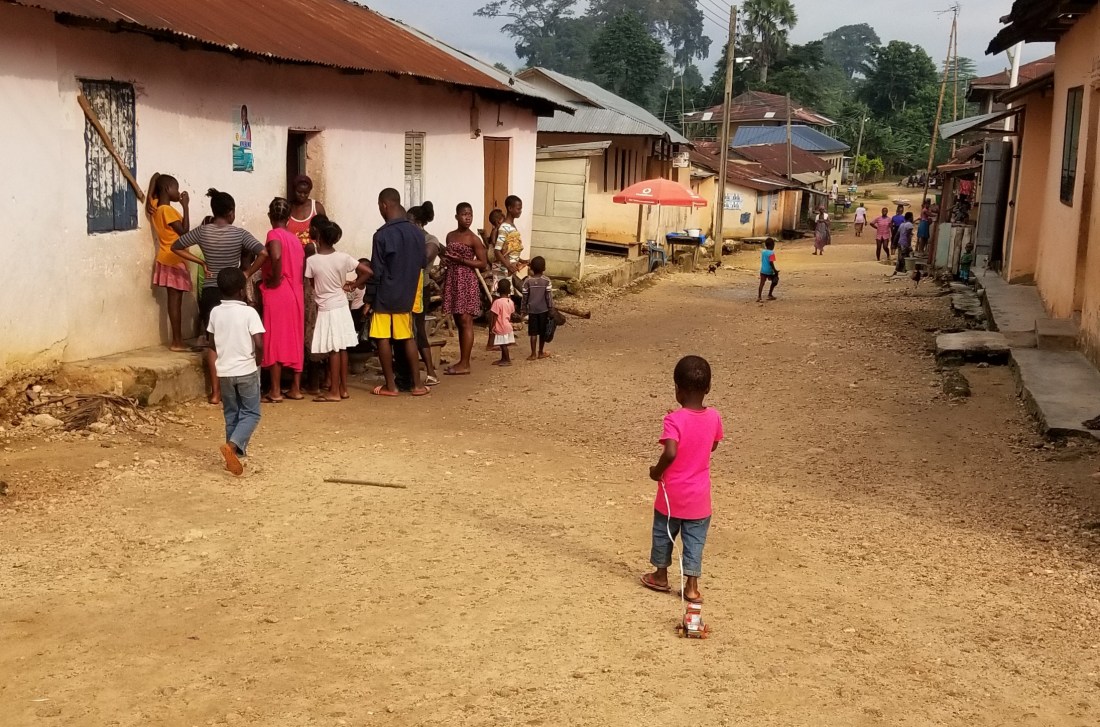
There were always lots of interesting things on the path to town. Along the right side, the brown skittering lizards darted this way and that, making a ch-ch-ch-ch sound through the piles of dead plantain leaves and plastic bags. Further up, there was a patch of exposed rocks and pebbles which always had one or two snail shells hidden among them. Maybe today there would be another line of ants marching determinedly head-to-abdomen like she’d seen last week. Maybe that puddle at the top of the path would have that little family of ducks again. She meandered in bursts from one curiosity to another, every minute pausing with downcast wonder until she remembered she needed to keep pace with her mother, who plodded on firmly around rocks and mud puddles. The wooden wheeled toy trundled and tumbled along behind, dismayed at the white ribbon yanking it ahead.

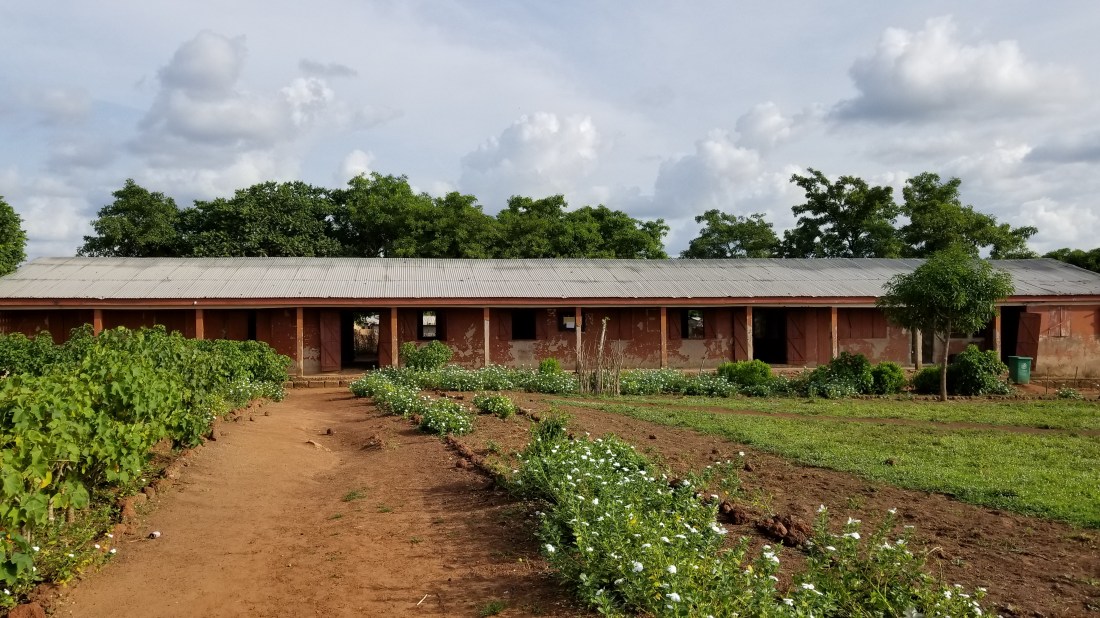
Passing neighbors’ tree-nestled houses and streams of air laden with the scent of drying cocoa beans, they emerged finally into a clearing with the schoolhouse on one side and the tall steepled church on the other. The girl stood and stared with liquid eyes at the long schoolhouse with its numerous doorways and windows and porch columns. The big kids in blue and white uniforms congregated slowly upon it from all over town, sweeping its rooms, shrieking up and down its porches, wielding cutlasses on the tall grass surrounding it. What an exciting place, what a scary place. She was torn by a longing to be grown up like the kids across the field, and yet didn’t want to leave the quiet and calm she’d always known. With a sigh, she skipped ahead to the roadside where her mother had cast a quick glance backwards.

The dirt road plunged between wood and plaster shacks and houses. In pinks and blues of chipping paint, in dull browns and grays of old wood, in steely brightness and deep burnt reds of rusting tin roofs, the town spread outward from its rocky sloping road. Standing in doorways overlooking it, walking across and up and down it, dealing and squatting and haggling and wandering throughout it, the town’s people and animals moved among and about on the brown-red artery. Shopkeepers, schoolchildren, dogs, old women balancing baskets, old men playing checkers, a line of goats with nervous dark eyes, a preacher with a megaphone – they called and chittered and cried out in the sharp dust, sunlight, metal, rocks, droppings.

Her mother had made her way deftly around standing crowds and stalls until she was out of view, but Maduwa knew the way to her mother’s shop, and so kept plodding on with her wooden toy in ponderous tow. She smiled shyly at the men playing checkers, looked wide-eyed at the group of young adults talking passionately, dodged clumsily around the couple of goats crossing the road with mild panic. Finally, up ahead she saw her mother stopped and unlocking the door of a storefront. She trotted the rest of the way for a reason she didn’t know.

Half an hour later, seated on a small stool next her standing mother, she ate slowly from a bowl of fried yams. Young girls and old men passed with staccato laughs and gravelly greetings. A creaky car grumbled past, crunching its way down the road around potholes and chickens. The preacher paused his proclamations to address a technical difficulty with his megaphone. And she, her stomach full and the breeze wisping coolly across her face, felt her eyelids heavy.