Buses, Brooms, and a Chemist

Sunday, 19 August 2018

9:00 A.M.

I stared down at my folded arms. Tanned skin, blushing with a day-old sunburn, glistened solidly with a full layer of standing sweat. Hairs disagreeing over blonde and brown thrust themselves through this shining film into the stagnant air above. My body teetered on that familiar edge of warm and hot, where a shaft of sunlight pushes you into sticky overheated uncomfortability and a soft breeze soothes that stifled suffering, if only for a moment. I sighed.

The luggage-laden white man I’d come to this station with, the last companion of a troop of nineteen I’d set off with two days ago, boarded the rickety bus next to mine and disappeared – maybe for months, I thought. My eyes swept melodramatically over the vendors, wanderers, and loiterers, searching for familiarity. Nope, no obruni here.

A hunched old man, white hair sharp against his midnight skin, reached a shaky wrinkled fist towards me and rapped hard on the window. I started and glanced down at him then looked away – but it was too late. Eye contact achieved, he implored my right ear in miserly tones, cupped palm held upwards. I winced as I always do. As his syllables blended with the Babel-talk buzzing in the station’s shops and corners and engines and dust, my mind grasped for a response in a language the man likely knew even less than I did. Maa kpa ilik. I don’t have money. But why lie?

He moved on and was replaced by a woman my age balancing a large punchbowl full of chilled soda bottles on her head. I smiled as kindly as I could and waved her away, shaking my head. A small boy with a similar bowl full of crackers and dry snacks stepped into her place. I did the same to him. Then a young girl with meat skewers, and then another with chilled bottles again, then a man in his late twenties with a two-foot stack of folded brightly colored fabrics. I faced slowly forward as the gracious smile decayed on my face. From the corner of my vision I saw a young man approach my window selling small electronic accessories. Unconvinced by my open-eyed nap, he reached up and palmed the glass with a soft bump. Frustration burning in my eyes, I wheeled around and accosted him silently. He stared right back at me – but not at me. He swept over my backpack, my watch, my headphones, my hair, my skin, my country. I was glad I didn’t need anything he was selling.

10:00 A.M.

The sound of an ancient engine clearing its throat, over and over and over. Wanna-wanna-wanna-wanna. We idled at a police checkpoint, in a line of vehicles waiting to pass through the bottleneck made by a blue-uniformed man and a line of cinder blocks in the road. Every few seconds the diesel growl surged into a hurried roar as we inched forward heavily in the lowest gear. Finally our turn came, but instead of speaking with the driver, the guard simply waved us forward. The driver nodded and pushed us into second gear, then into third, then into fourth as we picked up speed and wind. I laughed to myself. I might never understand this country.

The air and the ground were dark with recent rain. Grasses and trees surged to life hastily and determinedly, stretching out across the gently rolling flatness in the lush greens and woody browns of a wet season. Above, the sky ambled by in a thousand shades of blue and gray – clouds of wisps and cotton and wool and iron drifting lazily in front of a sapphire stage. There was the smell of water and leaves, earth and grains, skin and engines.

We passed a small stone monument which read “Diepo – 66”. Sixty-six more kilometers to go on this ride, how wonderful!

I smiled as I leaned a bit out the window and inhaled. The wind was strong against my face but fresh in my lungs. The sun was yellow and intense but the day below it was new. The tires below me were bumpy and rude but they pushed me forward. Forward! How special, how different – to be moving on my own with no schedule tomorrow. No lessons, no lectures, no rules or structures or bindings, not even any meals I was obligated to eat. It truly was a clean slate for me in this place. Today was a real start, a circle on the calendar, and I knew it. I leaned back in my seat, drenched with the euphoria of travel and adventure.

“Diepo – 63”.

Sixty-three kilometers! What luck, that I have time for twenty more such moments of breeze and plains! Oh, how I hope these two hours become two years in this country. No pothole or rainstorm can drain this surging tide of free-wheeling optimism this morning brings.

3:00 P.M.

Fishing the key out of my pocket and turning it in the lock, I was aware of a nagging in the back of my mind. Something I knew but had forgotten about. Something I’d been pushing away from my notice since I landed at the airport in Accra in early June. Something … something … hmm.

I pushed at the gray-painted door. Nothing. I shoved against it with my shoulder and it skidded open, scraping against its misshapen wooden frame.

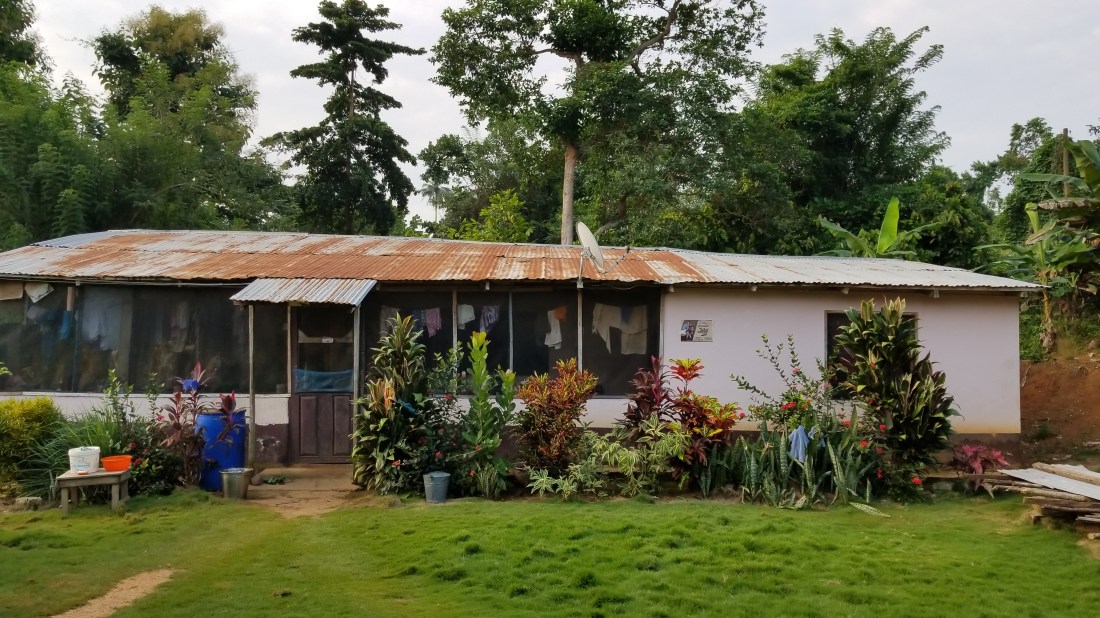
Dust wafted sharply into my sinuses. A new tin roof, glinting dully in the dim light, sat out of place above old wooden rafters. Plaster walls painted lime green cast an eerie light on the hard concrete floor. To the left sat a foam-mattress bed on a sturdy old wooden frame, topped with a blanket and a duvet cover of mouse droppings. Holes were scattered throughout the room – rotting chunks missing from wooden beams, a pair of rough four-sided gaps in the walls (a door behind and a window ahead), potholes in the thin floor exposing the soil below. A fine layer of dirt lay on every square inch of the bed, the rafters, and the ground, even clinging loosely to the cobwebs lining every edge above and below.

The nagging grew stronger and more insistent. Rising from a murmur in the back of the crowd to a buzzing throughout to an up-front clamor, it raised a silent fist and knocked on my bus window. Too slow, I realized I was turning my head to listen.

“What now?”

Oh. What now? For ten weeks I knew – no, for the past year I knew – this moment would come, when I would walk into my strange room all alone with all of the things I’d brought to live with. I would stare at everything I had and ask, “What now?”

In the dusty silence the question reverberated off of the four walls, demanding, urging. What now, what now, oh no, what now?

First I should sweep the floor. I laid hold of a bundle of straw in the corner tied together with a decaying string and, working from the opposite corner back to the door, pushed the piles of dust towards the door. What now?

I was hot and sticky from that work in the draftless room. Opening my suitcase, I removed a change of clothes, soap, a towel, and a sponge. I filled a bucket with water and took it all to the shower area, washing myself with hurried desperation. I dried off with dismay. The question returned. What now, what now?

Well, that blanket with mouse droppings should be replaced with the bedding I brought. I carefully folded the blanket to capture the droppings and took it outside to pop it out, then rummaged through my things and brought out the clean sheets. In a few minutes the chore was done and I was staring at my success with mounting panic. What now, what now, what now?

There was the mosquito net to put up, but what after that? I could begin to organize my things on the floor, but what would that do? I could call Colleen and my family, but what would happen after I hung up? How could I make it to evening and to bedtime? What would I do at midnight, and at two in the morning, and at sunrise? How could I bear to wake up in that bed, or even get out of it, and lay back down in it?

Outside, the bass beating of music broadcast at full volume matched with the thrumming in my chest. My attempts at finding positives fell like tiny drops of rain on parched ground. A sense of agitation and confusion made my knees weak, and finding no chair to sit on, I sank to the floor and stared back out the doorway.

Monday, 20 August 2018

10:00 A.M.

I was sitting again in the same place, mindlessly playing a game on my phone. The three days of travel insured that I slept hard, if not well. Hunger gnawed dully at my stomach but an empty appetite kept it firmly under heel.

The dim sounds of morning activities drifted in through the open door and window. Children playing and calling to each other, livestock bleating and baahing and lowing and crowing, motorcycle engines droning, Afro-pop music booming distantly. Every few minutes a conversation faded in, climaxed, and faded out as a group passed by. I realized with a wry smile that I was hiding from them.

Getting up and grabbing the straw broom again, I resolved to sweep the whole compound. From the edges of my small shared porch I gathered the dirt and dead insects in growing piles, then pushed it all to the drain. I was just standing up from this last part, noticing a dull ache in my back and head, when I saw a young man and woman about my age walking past my compound with apparent excitement. Both of them staring at the phone the woman was holding at chest level, they wore smiles full of glee and … wait, is that mischief? Pausing in stride, the woman held it higher, pointed it directly at me, and … oh.

So my community has discovered the zoo animal that’s just moved in.

That, more than the growing hunger, more than the boredom, more than the sense of confused abandonedness drove me outside. The secret’s out. They all know I’m here, of course, and I’ll be damned if they think I’m a recluse.

I’m just going to drop by the small shop across the way and then buy food off the street. If the conversation at the shop fizzles out, I’ll just say I’m going to get food and then I can go back and eat by myself. Yeah, that’ll work. Oh but that’s so terrifying. Why?

My feet slid into sandals and traipsed towards the gate of the compound. Wait, wait, I’m not ready. What will I say? What is the greeting in their language? What was the local name I wanted for myself? But my deaf hand reached out and pushed on the gate in front of me. Oh, but if it goes badly I’ll start off as a fool here – here in my new home for two years! I paused at the open gate. Where in these mud-walled homes is my deliverance from the hurdles I’m putting in my own path?

My deliverance, it turned out, was thirty feet away.

1:30 P.M.

I stood in the doorway of my small room, staring with new eyes at its walls and webs. A meal in my hands and a small smile on my face, I soaked up the relief surging like waves over me.

The small shop I went to – a pharmacy, or chemist’s, as it turned out – was run by a kind middle-aged man with surprisingly good English. Talking with him and with other community members who were dropping by, my anxiety melted away and the panicked alarm bells finally quieted. Then after chatting for almost two hours, I went to buy food from a street vendor, had a hilarious failure of a conversation in the local language, and returned to my room laughing at myself.

I’d forgotten, in all those weeks of cultural, language, medical, security, and even culinary training, that the first thing I need is something only I can do for me. I need people. I need people here that I live with, that wake up to the same roosters and hide from the same rainstorms and duststorms, that feel and breathe the same everyday life as me. Travelling so far from everyone I knew, I hadn’t realized how important it is to have a network, a community, right here that I can call my own, as well as those connections back home. I hadn’t realized it until I was perched on the low wall outside the chemist’s shop, chatting about goats and bicycles. Returning to my luggage, I had the same feeling as on the first day of kindergarten, clomping through the door in my new tennis shoes saying, “I made some friends today!” Is it silly? Maybe. I think it’s just human.

So then, what now? Now it’s more walking and more open gates, more chemists and carpenters and tailors and shopkeepers, more failed conversations and more laughs because of it. This newness will be at times exhausting and at times jarring, but I’m lucky to be here in this time of giving, and learning, and living. Thanks for staying with me, y’all, I’ve got a lot more to share.
Boiling Teeth

Thursday, 5 July 2018

20180706_083317.jpg

It’s not so easy to do homework.

It’s not so easy, getting up at 4 AM – saying morning prayers, sweeping the house and yard of leaves and sand, walking as far as I have to with an empty bucket and returning balancing one full of water on my head, repeating that, repeating that again, bathing and eating, and putting on my uniform – to find a pen somewhere around the house so that I can write at school.

It’s not so easy, arriving at school – sweeping the classrooms, fetching water for the teachers, and cutting the grass – to find time to copy the assignment from my friends.

It’s not so easy, sitting in class – waiting for Isaac to finish using the pen I lent him, squirming in the uncomfortable desks, avoiding the harsh gaze of my teacher, and trying to follow the Science lecture given in English, my second language – to understand today’s lesson.

It’s not so easy, coming home from school – running errands to the market, helping with the cooking and the cleaning and the laundry, enduring a sharp smack here and there when I make a mistake or get caught idle, eating, bathing, and cleaning – to remember that I need to pull out my notes and push through my exhaustion a little bit longer before I can sleep or even just stare at the wall.

20180706_083211.jpg

It was a short assignment to grade this morning.

List 2 physical changes and 2 chemical changes.

On the scarred wooden table serving as a teacher’s desk was a stack of homework notebooks. Beaten up, missing pages, perpetually damp with humidity, each notebook was open to the homework assignment I was grading. I started with the top of the stack.

  1. Boiling water. Brushing teeth.
  2. Digestion of food. Liting a match.

I corrected the spelling error and gave it a 4/4. Next one.

  1. Boiling water. Tering paper.
  2. Digestion of food. Liting a match.

Good.

  1. Boiling teeth. Tering paper.
  2. Digestion of food. Liting a match.

Boiling teeth. I thought about it. Clearly the student was trying to copy someone else’s answer and mixed up “boiling water” and “brushing teeth”. But it was technically a physical change, as long as the boiling water just heats the teeth. 4/4. Next notebook.

  1. Boiling teeth. Tering paper.
  2. Digestion of food. Liting a match.

It would have to be a review day.

Word Processing Application

Wednesday, 27 June 2018

In large letters he wrote the day’s subject on a stained and scarred whiteboard: “Word Processing Application”. Stepping back and inspecting his work, he scrubbed through the last word with a chalkboard eraser and rewrote it; then, capping the marker and exhaling, he turned around. His face was stern and impatient.

“Do you know it?” he asked shortly, gesturing widely at the board behind him.

“YES,” they answered in unison.

“What is it?”

The sea of eyes and faces, so vocal a moment before, shrank back in hesitating silence.

He took a straight-backed step towards the front row and asked again. “What is it? What is it?”

A slow breeze oozed in through the open windows, paused, and wandered out the other side of the classroom. There was a faint smell of dust and dirt, ink and paper, trash fires, and rain.

“Fidelity, what is it?” A girl in the second row flinched and stood up slowly, smiling meekly. Her eyes darted from the board to her closed notebook to the polished shoes of the man standing so tall in front of her. She breathed in, out, in – opened her mouth a bit – and then let it fall closed again.

Turning crisply from her, the teacher pointed to a thin boy intent upon the nearest corner of the bare concrete floor. “William, what is it?” Fidelity melted back down into her desk.

William stood up sharply with the air of someone for the fourth time searching their suitcase for toothpaste. His eyes bulged confusedly. “The combi – combination – of letter-”

“No.” The teacher waved downwardly at William and the 14-year-old sat gratefully. “You do not know it,” he said to the class. “That is Word Processing.” He pointed back at William. “What is Word Processing?”

William stood up again and recited, “Word Processing is the combination of letters, figures, and symbols to form words and sentences.”

The teacher nodded and started back towards the board. “Clap for him.” All together the students clapped a quick simple rhythm that shook the room’s gray silence.

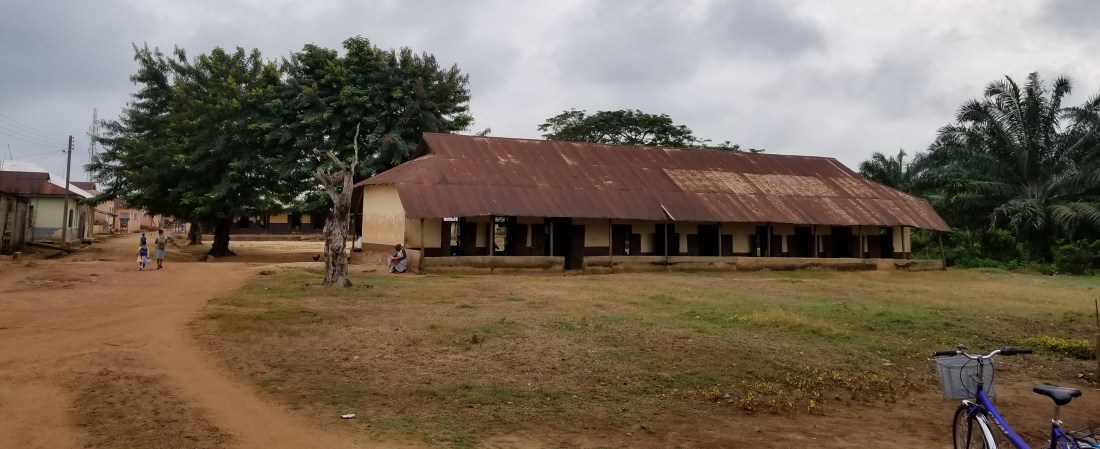
A short jog out the windows was an identical long structure of a schoolhouse in sectioned rooms. Its dull-painted cinderblock-and-plaster walls were broken in regular intervals by windows and doorways. The long tin roof above dripped and dried in the sunlight of a recent downpour. Between the schoolhouses was a wide field of trodden grass filled with blue-uniformed young schoolchildren. In packs they shrieked and ran and loitered chatting under the sparse shade trees. Above them, flitting from branch to branch to rusty tin, birds tweeted and sang. From the crossroads a few blocks away the percussive speech of a preacher on a loudspeaker boomed its way faintly through that twittering recess field to the classroom doorway.

Written on the whiteboard was the definition of Word Processing as said by William, the definition of Word Processing Application, and a short list of examples:

Word Processing is the combination of letters, figures and symbols to form words and sentences.

Word Processing Application is a computer programme that help us to create, edit and format a document.

Examples of Word Processing Application
1. Microsoft Word
2. Wordpad
3.

“What is another example?” The teacher raised his arms slightly. The response back was a dim confused muttering. He capped the marker. “How do we open an application? Don’t you know how?”

“YES.”

“You know the steps?”

“YES.”

“Alex, what are the steps?” He pointed to a tall young man with an athletic build in the back row.

Alex raised himself with a sideways glance at the students around him. “Click on All Progr-”

“Mary, what are the steps?”

Alex remained standing in disappointed silence, watching as Mary glanced back at him from the front. “Click on Start Menu. Click on All Programmes. Locate the application you want to use. Click on the application you want to use.”

The teacher nodded. “Clap for her.” Again the class clapped the applause rhythm as Alex and Mary sat back in their desks. On the board, the teacher wrote the steps. A few students read along out loud, as if from dim memory completing each word just before he finished writing it:

1. Click on Start Menu.
2. Click on All Programmes.
3. Locate the application you want to use.
4. Click on the application you want to use.

“Where are your keyboards? If you have not taken out your keyboards, do it now.”

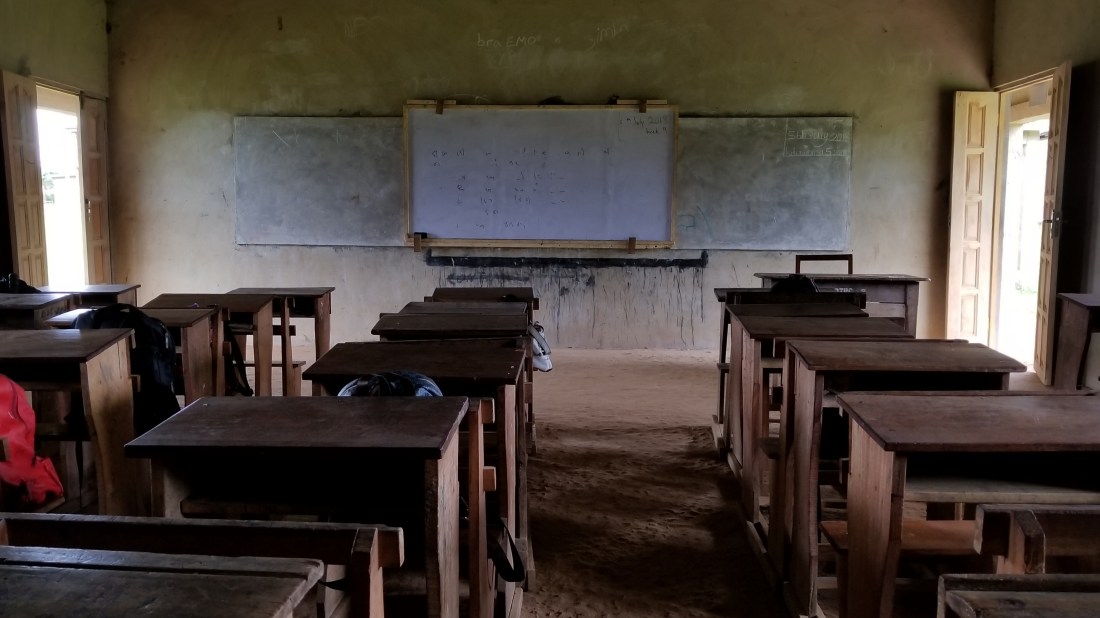
The desks in the classroom were ancient and wooden. They were missing sides and crosspieces, and they creaked and groaned as the students shifted. Like tables in an old saloon, they had chunks and chips missing here and there, marks and stains on the seats as well as the desktops. The corners were dulled, the edges were rounded, and the oil and polish from years of young hands reflected dimly the light streaming in through the windows.

Each student pulled from these desks a sheet of white paper printed with the keys and buttons of a computer keyboard. Some had doodled and sketched on the printed image, drawing cars and dresses and circling the letters of their name.

“Say the steps together.”

“CLICK ON START MENU. CLICK ON ALL PROGRAMMES. LOCATE THE APPLICATION YOU WANT TO USE. CLICK ON THE APPLICATION YOU WANT TO USE.”

“Are you getting it?”

“YES.”

“Are you getting it?”

“YES.”

“Are you getting it?”

“YES.”

“Okay. Copy all of this into your notebooks.”

He patrolled the classroom as the students, heads down, crowded their notebooks in a meticulous effort of checking and copying every letter on the whiteboard as well as they could. Some with tongues out a bit, some holding their pens at wild and weird angles, they paused as he passed, at the same time trying to hide their penmanship from him and bracing for a comment. He said nothing.

After ten minutes, he returned to the front, marker in hand. “While you finish, I will write your homework on the board. Copy this down too.”

Homework: List 6 examples of Word Processing Applications.

Obruni


Tuesday, 19 June 2018

Obruni is a local Ghanaian word for which the simplest, most direct translation is “foreigner”. But really, it is a word that means as little or as much as you think it means. For instance, it was first used to refer to the Portuguese explorers that initially set foot in this region of West Africa in the 15th century. Then it simply meant “white man” (that was a notable feature for the native dark-skinned peoples living here), and to some people that’s what it still means today. Or it could mean much more than “white man”. It refers to women. It refers to people of South Asian and East Asian descent. In fact, it refers to anyone at all who doesn’t have dark skin. And if a dark-skinned person turns out to be African American, as some of my fellow PCTs are, they will probably be called obruni too. Yet a native-born light-skinned Ghanaian will probably be called obruni all their life. So what does it mean, really?

On a typical day in my host community (Peace Corps asks that we don’t mention the name of the town), I wake up around 5:30 or 6:00. I lay in bed for a while and consider going on a run, but by the time I’m outside the mosquito net and tucking it back in under the mattress, I’ve usually found a reason why I shouldn’t today. I fumble around the room for clothes and shower supplies, unlock the door to the sitting area, and make my way across the small yard to the latrine and shower area.

The house itself has a narrow sitting area which functions as a screened porch, and three similar-sized bedrooms – one for me, one for my host parents, and one for the other six or twelve people who live here (depending on how many visit for the weekend). It has electricity but no plumbing. Water is hand-carried in from various pumps in town, or it comes from the sky. The kitchen area is a short walk down the hill from the main house, and consists of a cinder-block-and-wood enclosure with a couple of fireplaces on the ground surrounded by cooking supplies and equipment. Compared to the rest of the town, I would guess my host family is upper middle class.

It’s dark and dense in the latrine, and if you try to entertain yourself with Sudoku on your phone, the flies will focus their wild buzzing on your lit-up head and face instead of on the entrance to their home (a home whose threshold you are blocking). The sweat dripping from your nose and eyebrows isn’t so bad when you open the door to the outside and it cools all at once, and I must say the air immediately next to a latrine never smells sweeter than in the moment you exit the latrine. In the shower, the first bucket of water you pour over your head is always the coldest, so I usually get it over with immediately. All in all, I’ve got my whole bathing routine down to about a gallon and a half of water, which is weird to my host family but will be a helpful skill if I’m sent to an especially dry region.

By the time I get back to the house, my host mom has usually brought my breakfast to me on a tray, covered with a lace doily. She’s figured out I like eggs and oats, so that’s all she serves in the mornings. I eat alone because the rest of the family is eating in the kitchen, doing chores, or cooking (and they get uncomfortable when I invade the kitchen) except for my host dad, who also likes to eat alone in his room. Don’t get me started on Ghanaian eating customs. I’m still trying to figure it out.

Then I usually do some cleaning and organizing myself, including prepping for the lessons I’ll be receiving and giving today. Dress is always business casual because of my high status as a teacher (and because of high wardrobe standards here in Ghana), and with a nice film of sweat already forming on my arms and face, I’m off to training.
Walking past the schoolhouses I hear excited cries of hey, hey, hey and obruni, obruuuuniii! On the paths and roads through the town, sometimes peeking shyly from windows and doors and sometimes standing firmly in the road, small children glance and stare at my strange skin, my soft hair, my blue eyes. I smile, wave, and greet them in as much of their language as I’ve learned so far, but more often than not they return my poor Twi with silence. I’ve found high fives are a language we all understand, though. Adults in town, sometimes charmed by my attempts at language and sometimes exasperated with another foreigner smiling and waving, generally exchange at most a few lines of standard greeting and move on.

After four hours of language and technical (teaching) training, I return to my host house for long enough to peel off my hot clothes, sit down and eat, switch out my books and notes, put my hot clothes back on, and head back out for four more hours of learning. My host mom always has my lunch ready for me, and let’s just say that within the first nanosecond of looking at it I can guess how many Tums I’ll be taking today. Chicken and rice? One maybe. Banku and fish? Bring the bottle. Maybe I should ask her to dial it back on the banku.

In the evening I might do some shopping for necessities, but I’m almost always back at the house by 18:00. By the time I’ve visited the latrine, showered, and changed into cooler clothes that still cover lots of skin (bugs, as my leopard-print skin can tell you, are the worst in this region), my host mom has served up another lovingly prepared mystery meal. I try to eat it quickly so I’ll have time to scout around town for a decent cell signal to call home (usually Colleen) before it gets too dark.

One way or another I’m always back in the house before 20:00, which gives me enough time to interact with my host family some more and help my host brothers (ages 7 and 9) with their homework. I’m usually in bed by 21:00.

Around this time of day last week, my host dad was playing gospel music on the radio as he almost always does, but I was in the mood for my own tunes. I asked him if it would be okay for me to play a few songs, and he agreed with a “Yes, yes!”. Now, I don’t know how many of y’all like old country, but I have a playlist of music that my late grandpa loved to listen to, and I love it too. I’m talking Conway, Patsy Cline, the Hag, Jean Shepard, Faron Young, Ferlin Husky – all those good old songs. Well, I started shuffling from that playlist, and from the first few notes my host dad’s eyes just lit up. He started asking about the music and the words, and commenting on the ease and deepness of the notes and rhythms. When I told him it was music from when he was young, and in my home region we still like to listen to it, and especially when I told him it helps me remember my grandfather, he smiled and nodded along with the shuffle beat. Turns out that even an old Ghanaian prince (did I mention he’s a prince?) can appreciate a good old country song.

I was chatting brokenly with him the second night I was here, and he was talking about how, in his opinion, the Ghanaian people weren’t being well provided for by the government. Then he paused, and with sadness and matter-of-factness in his eyes, he said to me, “The people of Ghana do not have the good things Americans have.” I was stunned. I tried to come up with some kind of caveat, some way to encourage him and show him that Ghana has wonderful things in it and that I’m already seeing them. I said, “People in the United States, they are not happy. They do not smile as much as Ghanaians. Maybe they have big houses, but many are still unhappy. Here you laugh-” But he cut me off with a shake of his head. “For the black man, everything is black. For the white man, everything is white.”

The Peace Corps training staff and other Ghanaians who have come to know us well insist that obruni is not a derogatory term. “The children don’t know not to shout it at you.” “If you tell them your name, they will not call you obruni.” “It really just means ‘foreigner’.” It’s all true. And as a privileged minority in Ghana, I really don’t mind if obruni is my identifier – because, well, like I said, it’s true.

At the beginning of this post, I said that obruni could mean a little or a lot. For me, there’s no mistaking what it means. It’s the mosquito net I need and expect. It’s the lock on my bedroom door. It’s the latrine which has in fact been fixed up comparatively nicely for me. It’s the room I have all to myself. It’s the training my host mom had to receive to cook food for my unseasoned stomach, and it’s the cramps and Tums I don’t go anywhere without. It’s the nice American clothes and the sweat shining on my bug-bitten skin. It’s the calls of schoolchildren hopping from behind windows. It’s the giggles and laughs when I squat low and offer high fives. It’s the genuine appreciation from people around town when I attempt some Twi, and it’s the mild offense taken when I forget to greet someone I pass on the street. It’s the pride my host brothers display when I greet them in front of their friends. It’s the excitement my host dad and I feel as we share our music with each other. Put simply, it’s the details of my life here that are just as new and strange to me as they are to the people of this town.

More than that, though, obruni is the moment I realize that my host brothers, after a long day of school and chores, can’t do their homework assignment because they weren’t taught how to use a dictionary. It’s the “no” in their eyes when I ask if they understand a math problem even though their mouths say “yes”. And it’s the response I wish I’d given to my host dad – to somehow tell him that he’s right but I wish he was wrong, and if everyone agreed that he was wrong then maybe it would be true.

Obruni is why I’m here. I could ignore it and just live in this country for two years as a math teacher and then go home, but then why go to all the trouble and leave the people and the air conditioning I love so far behind? No, I’m here to share and learn, take and teach. After my time here I want to be able to show my friends and family the different lives of people far away, such foreign foreigners and yet such human people. And I want to have brought at least a few people here just a little bit closer to their own self-achievement – to give the brush to young minds who know they can paint their country any color they want.

Clay and Sweating

Saturday, 9 June 2018

Clay

Flying low over the treetops of far outer Accra, I gazed out the window at the landscape pouring slowly by. Below me were dark green tree leaves in thinning and clumping groups, cut through by clay-red lines of straight bumpy roads. Occasionally a collection of houses and shacks gasped out of a road intersection, its fingers of houses and people grasping for purchase despite the ever-pressing growth. Off on the urban horizon the reds and greens faded to grays, browns, and that strange color which when you get closer is a cacophony of flashy bursting advertisement, but from far away just looks like trash.

As we deplaned onto the tarmac, and rode the waiting buses to the terminal, and wandered to baggage claim, and passed through customs, and were greeted by PC staff outside, and stood in the sun for pictures, and rode other buses out of Accra, I missed those city outskirts. Through the chatting and smiling and hand-shaking and sweating, I missed the look of deep leaves and clay roads. It must have been when we’d driven an hour from the airport, and our tires started to redden with the road, that I exhaled and thought that this might be okay after all.

The city is lots of things, but first it is stressful. This has been true for every city I’ve seen, and even more true for the developing cities, where the dust and trash and dilapidated buildings and margin-chasing masses jostle you this way and that, all while the hubbub and honks make you feel like, despite all this, you must keep moving, keep moving. It thins us. I found myself, like those old slime toys that sometimes did and sometimes didn’t stick to the walls, thickening and pulling back together as we drove out of the impact of Accra. On the clay roads I felt the roots of a person slowly growing.

Ghana is a country of many years and many peoples, thrust into a world of the West as jarringly as its trees and tribes were severed by map-drawn borders. The streets of its cities hum with the spirit of fresh history; its citizens, streaming to urban capitals from village huts, bring sharp to the air their salt of the earth. And in that wilder land still there are chiefs and ancestors, libations and prayers, apart from the law, apart from our gods. We judge the tree according to its trunk and branches, and the country according to its city. But let’s remember too the roots – the soul – in that red clay.

Sweating

Have you ever sweat? I mean really, really sweat?

Have you ever walked upright through stifling humidity under the sun of the tropics, in slacks and a button-down? You sweat all the way into the tips of your hair. The salty slick beads fall through your eyebrows and into your eyes, around the nosepiece of your sunglasses, down past the edges of your nose and into the corners of your mouth. It cascades from behind your ears down your neck, filling the collar of your undershirt, seeping in spots to your button-down. From your armpits and the small of your back it rides your tucked shirt to your underwear, and the hot trickle keeps falling, keeps falling. From your belly button to your darkening waistband. From thighs and calves to soggy socks and squishing shoes. You curse your body for sweating so much. You think about how awful you’ll smell, and already smell. You wonder if you have enough clothes for this week, or even for today. And the sun beats down, and the rooms are stuffy, and the breezes are just never strong enough.

Have you ever peeled off sticky clothes for a muggy bedtime? You have to fight with your shirt and your pants until they’re finally inside-out in a pile on the floor, and you have to groan and lean over and pick them up and hang them to dry in the wet air. In the shower, no amount of pouring of buckets over your head cools your radiating skin, and with sweat still pouring down your face you towel off, never really cool, never really dry. Then, already sticky again, you lay on the bed. But the mattress returns the heat to you from below. The thin sheet you pull over yourself is too much. You throw it off. The air hanging over your chest and outstretched legs is far too much. You lay helpless. When you shift, the fitted sheet tries to roll with you. Your pillow is damp, the area below it is wet. The fan, if you’re lucky enough to have it, is feeble and insulting. Maybe it will cool before morning, you think. So you close your eyes and wait for the sunrise.

Staging

Tuesday, 5 June 2018

As I begin this post I’m sitting in the Washington Dulles terminal, waiting for boarding to begin on a direct flight to Accra. I, like the 33 other Peace Corps Trainees (PCTs) in black airport chairs around me, am alternating between thumbing on my phone and glancing out the window at the imposing letters of “SOUTH AFRI” on the part of the plane I can see. The smell of fast food fills the air as a few of us shovel fries and burgers into our mouths.

I arrived in D.C. two nights ago on an afternoon flight. As well as I could with two large suitcases and a backpack, I hustled through the dreary drizzle from the Uber car up the front steps of the National 4-H Convention Center. The guy behind the desk was very kind, first asking me if I was in the Peace Corps (French terms are weird), and then handing me my room key. But I only dropped off my bags and headed back out, because I was on a mission for passport photos (one of the things I forgot on my don’t-forget-these-things list).

En route to CVS, I worried about how woefully I’d misjudged how much luggage I should have brought. See, in the few minutes I spent in the room, I had time to glance at the things of my roommate who had come and gone, and he’d only brought a large duffel and a backpack. Surely he was a true hardcore adventurer like all of the other PCTs, while I had practically brought an entire moving van. Is everyone besides me going to have mountain backpacking experience, and perfect abilities in four languages, and 100 days on an isolated fishing boat in Alaska? Probably.

As it turns out, my roommate Ben did have that last thing and also the face of Tom Cruise (I swear he does). But besides that he’s pretty much a normal dude, thank goodness, as I found out when I returned and we chatted for a while. Oh, and almost everyone else brought as much luggage as I did. Stay close, Ben Cruise, I have extra Clif bars!

I called Colleen (she’s my girlfriend for those who don’t know her, and she’s absolutely wonderful and I love her, and I recommend everyone should have someone like her in their life) to give her a synopsis of my day. Then I settled in for a night on the bottom bunk (I got my own bunk all to myself, WHOOP!) in the quiet convention center dorm rooms. Except for the few of us flying in from far away, most of the Peace Corps folks would be arriving the next morning, so you could say the excitement was almost in the air.

Oh dear, I just realized how many details I’m writing. Sorry, I’ll pick up the pace!

Registration opened at noon and closed at 14:00 (please accommodate my 24-hour format, it’s just easier), which kicked off Staging, our first official PC training sesh! And it wasn’t just a bunch of paperwork like I’d thought it would be – we actually did some fun icebreakers and had a few really good discussions and scenarios about PC policies and practices. I came out of the five or six hour stretch in that conference room feeling much more confident, and more importantly, already well connected with my fellow PCTs.

We had the evening to ourselves, and while I think most of us headed to a nearby sports bar to watch a hockey game or something (I’ve never been called “sporty”, let’s just leave it there), I and a few others hung around at the convention center and ordered pizzas. Then I stayed up late talking with my parents and with Colleen some more, Texas and D.C. preparing for my imminent home-leaving.

Since starting this post, I’ve gotten on the plane with all my fellow PCTs, and we with a whole bunch of folks I don’t know are streaming east across the Atlantic for Accra. Having left a bit before sunset, we’ll be landing ten hours later in the early light of an African sunrise. It’s a good group we’re bringing to Ghana – the mixture of enthusiasm, determination, and sheer variety of shades of American makes me feel like we’re on as good an initial footing as we could be. I feel that we’re primed to do some awesome work in the next two years and to share the bits of home we brought with us while we’re at it.

But I already miss my good ol’ Red, White, and Blue, so keep it safe while we’re gone, y’all!

Just real quick, I want to say that I’ve been thinking about how I want to do this blog. You see, I really like to try to dive deep into specific experiences to try to make you feel like you’re right there too. But that doesn’t work when I feel like I need to summarize every event too. So while I might offer short summaries and background info, I think I want to focus closer on scattered pieces of my experience. Hope that’s cool. Let me know though!

The Journey Almost Begins

Friday, 1 June 2018

Do I need to write the date? I think this website will do that for me when it publishes. Oh well, either way it looks good.

Hello and welcome to my bare-bones blog site! There was some kind of formatting error in the official WordPress tour and it exited on the second step before it actually showed me how to do things, so it looks like this Peace Corps thing is gonna be a learning experience from Day 1. Exciting!

As I will have written in the Facebook post that links to this blog, I’m going to be flying to D.C. on Sunday, and then to Accra on Tuesday. Between now and then I’ll be figuring out how this website works, eating my fill of American food, and hopefully packing.

Aaaand I think that’s all I have to say. Thanks for checkin’ the net with me. Bye for now!