“Students must respect their teachers. This is not only true in Ghana – it’s true all over the world. Without respect, there is no attention. Without attention, there is no listening. Without listening, there is no learning.”
–
“You have twenty minutes more,” Solomon announced from the front of the classroom. Meticulously he erased the circled ‘30’ on the board and replaced it with a ‘20’. Turning to the class, he witnessed a few dismayed heads sink slowly back to their unchanging exam papers.
Solomon knew that quiet panic. It was not so long ago that he’d felt that heat in his ears, that dryness in his eyes. It was not so long ago that he’d stared just as cluelessly down at Science exams, nervous chills moving in waves down his back. It was not so long ago that he’d sat quietly, nodded, taken haphazard notes, glanced out the windows, snapped to attention, cringed, winced.
He sat in his chair and resumed picking at one end of the switch in his lap. He had focused on English during his teacher training; however he’d been made the Science master by Mr. Simon, the new headmaster, this year. Rather than admit to his weakness in the subject, he had just nodded with muted obedience in the September staff meeting, his heart in his throat. So it was redeeming in a way to see his students also finding Science such a difficulty.
The third-year students, he knew, were especially agitated about this test, as it was the national placement exam for Senior High Schools and Technical Institutes. The exam writing and grading was handled by others at the national level, but this year it was his responsibility to be present as a proctor. Solomon felt a small swell of pride at being chosen to proctor his students, known as he was for being a strong disciplinarian.
He stood up. Starting from the doorway, he made a patrol of the room. The star student, Kweku, at the front of the first row, was almost finished with the exam. “Good, Kweku,” he boomed, tapping Kweku on the back with the switch, causing the boy to jump slightly. Continuing down the row with slow deliberate steps, Solomon swiveled his head from left to right, left to right. Ama, leaning oddly due to her wild writing angle, was getting close to the end. Gabriel, well, he might pass after all, something for his younger brothers to aspire to. But John, no. Cecilia, no.
He sighed. With any luck, Mr. Simon would take the hint and move him to a different subject next year.
Rounding the end of the first row and starting up the second, he stopped. “Kofi, you cannot pass like that,” he huffed, looking with some perplexity from the back of the boy’s head to a nearly-blank exam. He took the paper from the desk, looking with resigned amusement at the poorly-answered free response questions. “I am sure you will not finish. You have used only one side -”
Kofi’s neck tensed. Solomon squinted at the scrawled message on the back of the paper: “Mr. Solomn is not teach is fool.”
A sharp slap of wood on skin rang out in the classroom. Kofi yelped in surprise and pain. Solomon’s face twisted into a sneering grimace. It felt good. He pulled his arm back and whipped the switch forward again. “Master!” Again. Solomon’s heart raced. Again. His eyes bulged. Again – and the switch broke across Kofi’s back. Solomon threw the remainder at the nearest wall and, turning quickly to the front of the room, marched furiously to his chair for the spare switch. Kofi sobbed. Barely pausing to pick it up, he moved in a rage back to the boy’s desk, arm above his head. Kofi, now looking up at his teacher, only just had time to lift his arm to shield his head from the blow. It came down hard on his forearm. Solomon reached with his free hand and wrenched the boy’s arm to the side. Nearby students wailed and shouted. Wh-cht, wh-cht, wh-cht. Three quick hits to the forehead, the cheek, the ear. Kofi lunged away from Solomon, upending his desk, bruising his hands, pedaling his legs out of the decaying wood frame, crawling up the next row, wiping blood from his eye, shaking to his feet, sprinting for the door, ducking from more blows, wh-cht, wh-cht, colliding with Mr. Simon, falling, rolling, rising, running, running, running.
–
“Many of the students will not even tell the truth in class. I ask if they understand and they answer yes. But then I quiz them and they fail. So they do not truly know. How can I teach with that dishonesty?”
–
It was unusual that the community reacted so strongly. It was unusual that parents came in force, demanding to speak with Simon. It was unusual that Solomon had to leave early that day. It was unusual that he never returned.
“I do not have time to explain again, Peter,” he sighed. A small boy in a faded uniform stood self-consciously in the emptying classroom. “Ask me tomorrow. You must go to closing.”
A new school takes time to get used to. This was even more true for Solomon, especially given that he was a stranger to the town. Especially … because of that other thing. He pursed his lips. But despite his unfamiliarity with the students and the weirdness of arriving in the middle of a term, it was good to be teaching English again.
Juggling his switch and lesson plans, he exited the classroom and started towards the small tree-shaded clearing which served as an assembly ground. At the front of three long lines of silent students stood Mr. Howard, the Mathematics master, his thin glasses slowly plunging down his nose amid sun and sweat. As Solomon drew closer, straightening his back and lifting his chin, he heard the last few words of the lecture Howard was giving to the student body.
“… for your own education. Pray to God tonight for better wisdom and learning skills. And thank God for your teachers. But you must also work for – oh, Mr. Solomon.”
“Mr. Howard, yes.”
“Do you have any message to add for the students?”
“No, thank you.”
“Then,” Howard said, turning crisply to face the students. “Close.”
As a body, the students brought folded hands to their noses, closed their eyes, and announced in a loud unison, “WE ARE CLOSING IN THE NAME OF THE FATHER, THE SON, AND THE HOLY SPIRIT. AMEN.”
“Eyes open,” Howard said.
“You.” The word barked from behind Solomon’s rigid arm and pointed finger.
A tall boy of large build hopped sarcastically to rapt attention – if such a thing can be done – and saluted. “Sir.”
“Your name is?”
“Mark.”
Solomon glanced sideways at Howard’s languidly interested face, then returned his gaze to the boy. “Mark, you were not moving your mouth. Then you do not know how to pray?” A scatter of giggles bounced through the group.
“Master, I was – “
“Pray again, Mark.”
Mark sighed and adjusted his uniform self-consciously. Then, in a sudden burst, he thrust his head high and shouted. “WE ARE CLOSING. IN THE NAME OF THE FATHER, AND THE SON, AND THE HOLY SPIRIT, AAAAAAMEN!” The last word he stretched almost into a line of song, letting the tone of his voice dance up and down before finishing his speech.
As the students suppressed horrified laughs, Solomon’s eyes smoldered darkly. His voice low, he gestured at Mark. “Come forward.” The student squared his shoulders and paced surely forward, eyes even with the teacher’s.
Wh-cht. A blow from the switch fell suddenly on Mark’s ribs. Wh-cht. Another sharp hit, in the same place. Solomon’s gaze drifted back up to Mark’s, who hadn’t broken his silent eye contact. Insolence. Wh-cht. Wh-cht. The boy flinched and blinked back tears. He leaned a bit away from the repeated strikes to his ribs. But he did not break eye contact. Those eyes – so insubordinate. So angry. So disrespectful. Solomon fumed. This boy was too prideful. He should learn about real authority, about how to properly look at a teacher.
Wh-cht. One stinging blow, right where it mattered. Right between those mocking eyes.
Mark fell to the ground.
–
“The Teachers’ Code of Conduct is misleading. It does not prohibit punishment in this way. The headmaster is allowed to do it as long as the reason, number of strikes, date, and student’s name are recorded and reported. No, no, even the new guidelines do not completely prohibit it. There are exceptions. Have you found the exceptions? Have you read the entire Code of Conduct? There are exceptions.”
–
The boys waited a long time for him. As the dusk stretched into evening and the evening into night, they lingered by his door. We need Mr. Solomon’s help with this assignment. Some tried to shoo them, to say they were up to no good. But they remained loitering in their nervousness, guilty smiles under hard eyes. They knew, the passersby knew, everyone knew – but didn’t quite believe – what they were there for.
Nobody warned Solomon.
Walking home after visiting a distant relation in the town, he was cheerful and full-bellied and humming. Not even bothering to flip on the porch light, he fumbled in his pocket for a moment looking for his key.
He heard a foot scrape behind him. Hair stood up on the back of his neck. Turning slowly, he recognized three of them as his students. All held switches in their hands – thick, knotted whips, barky silhouettes distinct in the moonlight. His heart thrummed painfully in his chest.
“Why are you here?”
But now he knew too.
–
“A teacher should educate a student about morals first, and about school subjects second. Morals must come first, because how can an immoral student learn the right thing? If he has no morals, what is he really learning – the good or the bad?”
–
It was a shocking, horrible breach of the bond between student and teacher. From where could students learn such disrespect and violence? This humiliation, this wrongness, was an outrage, and it demanded justice. “Our schools cannot run with this kind of behavior,” teachers said.
So they went on strike. In protest, all across the district, every teacher and headmaster refused to go to school for two weeks until the guilty students were forced forward with stony apologies. Then the students, the example made, were quietly expelled.
“Yes, expelled,” Solomon remarked with a frown.
“Ah – well, that is good,” Howard conceded. He raised his head, smiled, and offered a handshake. “And it is good that you are finally back. It has been long.”
Solomon motioned apologetically at his own limply hanging arm. “Sorry, it still pains me.”
“Of course, sorry.” The hand moved up to Solomon’s shoulder. “Then I believe we are late for our classes.”
They parted ways and Solomon plodded slowly down the open-air walkway. A hot breeze, smelling sharply of dust and smoke, moved over his face. Pausing at the doorway, he sighed and glanced backwards. Down the steps, across the playing field, around the garden, past the church, then back, back among paths, compounds, animals, people, shops – his little house. His dark porch.
Solomon faced forward. A strong inhale. Then chest full, back straight, shoulders up, neck high, chin forward, jaw set, eyes hard.
He strode into the classroom, a switch held firmly in his fluttering hand.
–
“Ghanaian students are not like the students in your place. They know that you will not hit them. They will think you are weak and they will not listen.”
Corporal punishment, although historically widespread in schools throughout Western countries and their colonies, has seen a major decline in almost all corners of the world since the mid-20th century. Today it’s mostly limited to places of strong conservative culture and weak educational resources.
Ghana is an African leader in the elimination of corporal punishment as a school discipline strategy. The July 2008 Teachers’ Code of Conduct, presented to the Ghana Ministry of Education and to the Ghana Education Service (GES), disallowed any administration of corporal punishment by teachers, considering it a “gross violation of the child’s rights”. In 2017, GES reiterated this stance for all public and private schools in the country, sending out for all teachers a Positive Discipline Toolkit that had been developed the previous year. In January 2019, GES again sent out a memorandum to all teachers and headmasters emphasizing the absolute unacceptability of the practice.
Despite this, corporal punishment methods such as striking, flogging, sun exposure, and painful physical exercise are still practiced in many Ghanaian schools and homes.




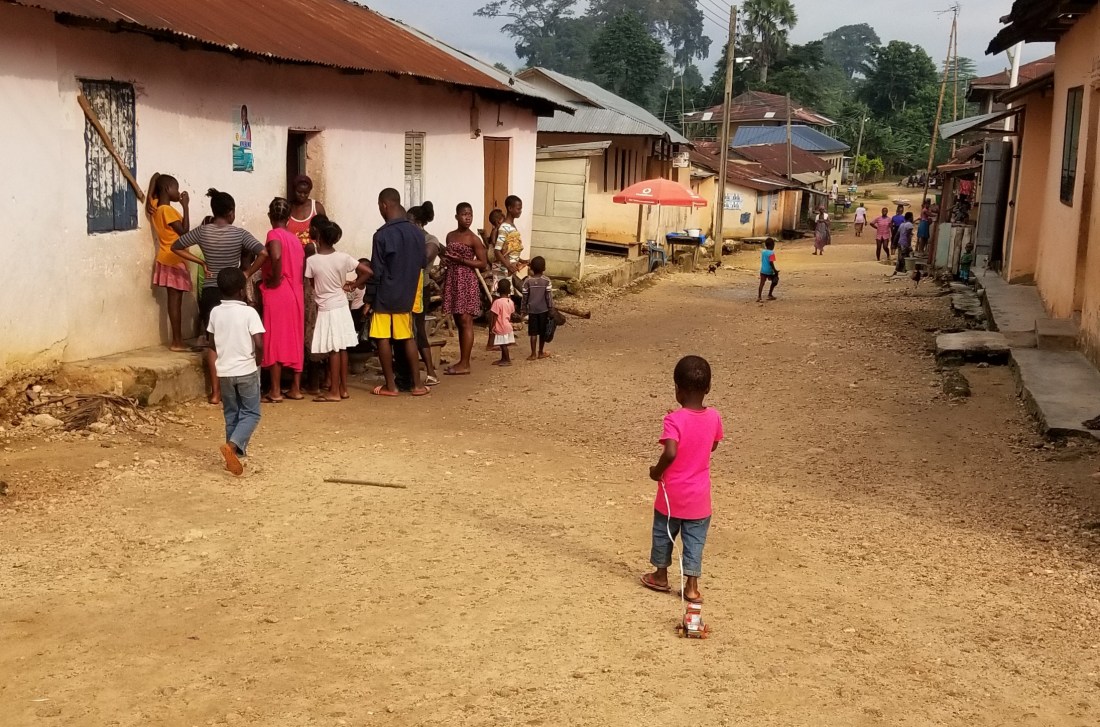
 Tim in Ghana: A Look into the Life of a Peace Corps Volunteer