
Thursday, 27 September 2018
Overhead, the sky looms hard and blue. A white-yellow sun stands powerfully above it, hands on hips, glaring down through the afternoon breeze at patchy metal roofs below. On a wooden bench we sit uneasily, fidgetingly, glancing out from the shade at the slow patrol of the day.
“Sampson, how many sisters and brothers do you have?”
“Ah, as for me, we are six. It will be three brothers and two sisters.”
“You are the oldest?”
“No, my senior brother is there. Then I come second. Then my junior brothers.”
“And your sisters?”
“One senior sister, one junior sister.”
“Oh, I also have a senior sister and a junior sister. But no brothers.”
At this, his eyes – usually restrained and brooding, like a spring bent uncomfortably out of shape – release into a grin, the smile washing down his face to a wide laughing mouth. His voice drops low and sly, and with a throat that wants to boom, he says, “Ah – then it will all come just to you!”
“Not if I stay living in Ghana!”
Before I’ve finished my sentence he’s surging backward with a terse “HAH!”, and a massive hand is coming down powerfully on his knee. “It’s true! Then even I will force you to return.” He rocks slowly with a humming chuckle, shaking his head.
After a pause his eyebrows raise themselves and push creases into his high forehead. He looks pensively downwards. “In fact, I was alone from my brothers in education.”
In rural Ghana, an education is a rare and special thing. Few families can afford to pay for all of their children to attend primary school, especially since every hour in the classroom is an hour away from the farm. But most can spare the expense and the labor of one child. To have a son with the knowledge of the town, speaking English, understanding government papers – this is a useful, and nowadays almost a required, blessing.
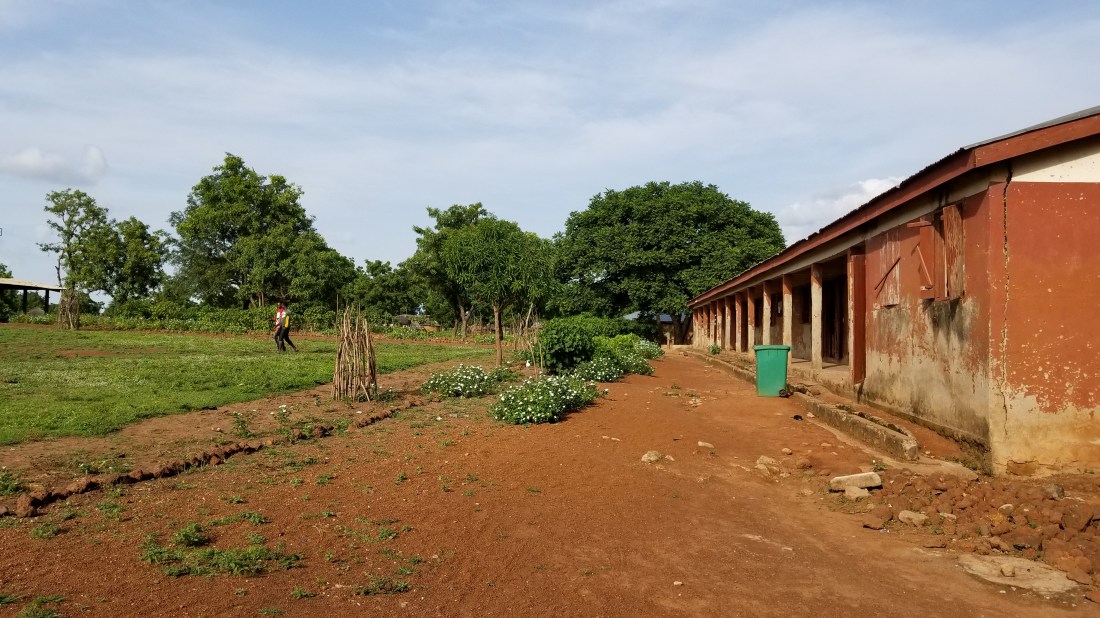
For as long as he could remember, Sampson’s father had always told him, “You will be the one for school.” As he toddled and ran and carried and worked, he knew that one day his father would call to him and say that tomorrow would be the first day in that long windowed building. Through the years he saw the older kids walking in their yellow uniforms through those tall doorways. Then some of the children that were his size began to join in too. Then even those that were smaller than him. “Father, will I go to school this year?” “No, not this year. You will work on the farm.” They sang and prayed so loudly in morning assemblies. Some days he could hear their voices from the field. Maybe if he could find a yellow shirt, he could stand with them in their lines and sit with them in their desks.
His senior brother alone was brave enough to talk to Father. “Please, he is already past the time to start. He can use the bicycle to go to market for supplies.” The silence lasted for two days, then the decision came down. On the next market day Sampson’s brother would go to market to buy a uniform and a notebook, and then Sampson would go to the school.
He exhales and sucks deeply from the warm water sachet in his hand. A cool breeze shocks its way across the skin of my arms and feet. High up to the east a cloudy darkness gathers heavily, sliding steadily west towards a perturbed sun.
His father had a white man friend, a missionary from America named Daniel. Sampson took quickly to school and had a knack for learning, and with Daniel’s tutoring he was able to perform ahead of many of the other students. Daniel began to talk about Diepo, the larger village nearby which had a better Primary School and even a Junior High School. One day during the planting season in Sampson’s second year of Primary School (P2), Daniel came to Sampson’s father. They talked for a long time, and in the evening Daniel left with a contented smirk. A week later, it was announced – after the break, Sampson would move to Diepo to live with his uncle, and attend Diepo Primary School.
The headmaster of Diepo Primary School received Daniel warmly when he brought Sampson, now growing wide in the shoulders, to the school office. The tall thin-lipped man greeted Daniel with a double handshake and spent a long while asking about his health, his wife, and his church. Then he turned to Sampson with a sudden battery of questions. Such pressing questions – about letters, numbers, days of the week – from a tongue that moved strangely in its mouth, accented with the rhythm of a different language. Sampson did his best with the interrogation, but growing in dismay, felt more and more with each sentence foolish and afraid. Diepo was too large and too fast. This was all a big mistake. He just wanted to go home. After a few moments more, the headmaster turned to Daniel and exchanged some words in rapid-fire English. A warm grin grew on Daniel’s face, and he rested his hand on Sampson’s forlorn head.
So Sampson skipped P3 and started at Diepo Primary School in P4.

The afternoon darkness deepens suddenly as the advancing line of leaden clouds obscures a resigned sun. Chill sandy wind hisses through green fields and brown houses. Cold drops come down with a tapping, then a pattering, then a steady clatter. We wait a few minutes for the rain to flush the accumulated dust from the rooftop, then position buckets just under the overhang, their open tops widest under a thickening curtain of water. Gusts of wind whip over and between the walls of the compound, disturbing our feet and knees with sheets of frigid water. We move the bench away from the overhang to the back wall.
Sampson worked his way through Primary School and, when the time came, continued on to Diepo JHS. In Sampson’s second year of JHS, when his father said he didn’t have enough money to send for Sampson to continue his education in Diepo, Daniel quietly took over the costs of supplies and tuition. He was a constant source of help and encouragement – not just to Sampson, but to any and all students that came to the missionary’s home. Sampson was growing tall and strong, able to carry anything his father could, able to answer more questions in class than most others. As his final year of JHS came to a close, he felt he could handle anything – except perhaps Tamale.
“You have to go to Tamale next year,” Daniel told him during the prep week before final exams.
Oh – no. Tamale. Such a giant. Such a monster.
Growing up, Sampson had never left his community of a few dozen homes until coming to Diepo for Primary School. Diepo, a much larger community, is still a lot smaller than the district capital, Kpambusi. And Kpambusi is a newborn goat compared to the hulking bull of Tamale. The capital of the Northern Region and the de facto capital of all of northern Ghana, it is a massive throng of shouting people and honking cars, tall buildings and wide streets, crying preachers and crowing birds and crooning mullahs. No, no, much too big.
But Daniel urged – he must go, he must finish his education. It wasn’t enough to know English and long division. A Senior High School education from one of Tamale’s Technical Schools was what Sampson needed to help himself and his family too. Get a real skill, a good income. You can come back to farming whenever you want to. Now, though, you have to take this chance.

The raindrops thin into scattered hiccups and the air recedes to a soupy stillness. A red-gold orb, with mild indignation, pouts on a horizon awash with crimsons, purples, azures, and silhouetted treetops. A far-off donkey brays with jarring energy. Still more distant roosters answer, filling in the pauses between dryly skittering lizards on the rooftop.
So, when his final exam scores proved enough to get him into any SHS in the Northern Region, Sampson went to Tamale. He even opened a small electronics roadside store with a friend, paying for most of his school costs. With Daniel’s advice, he took trade courses in construction, unlike most of his peers who went for government clerk fields. According to Daniel, “Those paper jobs rarely come and they always go, but everyone needs a builder.”
He was right. After finishing school in Tamale, Sampson returned to Diepo and had no problem finding work. One year later, he had enough money to marry the woman he’d known and courted since JHS, and a short time after that the young couple had a baby boy on the way. Though he sends money back home to his parents and siblings, Diepo is his home. He’s a pastor in the church Daniel built, a football coach for the children of his classmates, and as I tell him, the best Ghanaian mason I’ve ever met.
“Do you have more children now?”
“Yes, also a junior sister. And Cynthia will have one more soon.”
“So fast! That must be why you’re building a new house.”
Sampson cocks his head to the side in a wincing half smile. “That and the family. We are many.”
The sun, now fully retired, pushes its amber echoes up into the darkening blue. The smell of wood fires mingles with the weak di ka, di ka of far-off reggae.
“You said you want to go back for more school?”
“Yes, but my own children will start school in small time.”
“Mm.”
“Maybe if plenty of work comes, I will have money for my family and for more school.”
I breathe out and nod uneasily, thinking about how lucky his kids are.
“Then. Evening is here so I will please go.”
“Oh, of course.”
He raises his thickly built frame and begins walking to the half-hanging compound gate.
“Sampson, I have a question.”
Stopping in the gathering darkness with a scrape of his foot, he turns back towards me.
“You know I like to write for the people in my place. Can I write about you?”
Through evening air his face breaks into a smile with an amused snort. “But my story is just a normal one.”
Wonderful.

 Tim in Ghana: A Look into the Life of a Peace Corps Volunteer