Wednesday, 25 July 2018
She awoke to the sounds of the morning – roosters crowing, songbirds chirping, goats bleating. Clothes, rugs, towels, and mattress pads lounged in colorful cliques about the hushed plaster-walled bedroom. From the porch came the sound of her grandfather’s radio and her grandmother’s sweeping, and from the yard the rhythmic foamy sloshing of her mother washing clothes. From over the hill across the creek a breeze hissed through deep green leaves of plantain trees and fell into the open window. An airy dewy scent of plant growth mixed with dust and soil, old clothes and sleep.
“MAAAADUWAAA.”
“Maa!” she cried shortly in response to her mother’s call.
“Come help me with washing.”
Sitting up and rubbing her bleary eyes for a moment, she rolled forward onto her hands, jerked her feet to the floor underneath her, and finally straightened in the blue morning light. She padded across the bedroom to the weathered screen door and pushed it open. Nana was seated on a couch with a small plastic table in front of him crowded with eating bowls and school workbooks. In between bites of breakfast, he smiled and nodded at her as she passed to the porch door.
Suddenly she was on the hard concrete floor. Her brother, towering over her at nine years old and carrying a bucket of water which towered even higher, had stumbled into her and even spilled some water. He growled a reprimand downward, and her grandmother paused sweeping for a moment to issue a sharp rap on her back with a nearby switch. Tears threatening to replace the sleep in her eyes, she let out a quick confused sob before her mother called again.
“Maduwa, come help!”
She picked herself up off the floor and made her way outside, where her mother was just beginning a trek across the clearing to the clothesline with a bucket of washed and rinsed clothes. Casting a look over her shoulder, her mother gestured wordlessly to the washing waiting in piles to be done.
Her mother was a tall woman, made to look even taller by her thinness in the arms and in the waist. Her sharp chin sat firmly under high cheekbones and a forehead that seemed to take up half of her face. She walked with her head up and her bony shoulders pulled back, treading with purpose in every step – but there was something missing in the eyes. From out of the hard exterior stared a soft shiftlessness, a glancing hesitancy, a tiredness and a nodding.
Maduwa picked at the pile of dry clothes and put them one by one into the sudsy wash bucket. Then when it was about half full, she picked up one of the smaller items – a favorite shirt of hers – and began to scrub it against itself as she’d seen her mother do so many times. Dunk, scrub, scrub, dunk, scrub, scrub, dunk, scrub – pause and glare down at the fabric (her mother always did this every so often) – then dunk a bit more violently, scrub, scrub. Then, raising the small shirt up out of the water, she twisted it tighter, tighter, until it seemed no more water could possibly fall out of it. Finally, she lowered it into another half-full bucket of rinse water.
Her mother returned with the soft thump of a bucket in the grass. With a click of her tongue and a wave of her hand, she took Maduwa’s place as prime washer and demoted the girl to rinser. This was all right, though, as the rinser just had to dunk and twist – none of that difficult scrubbing. The tall woman spread her feet wide, bent down rapidly at the waist, and thrust her hands into the soapy water. Then, pulling out a long skirt, she flipped it deftly and in a practiced motion scrubbed it against itself in circular strokes, pausing every few seconds to replenish the water in the fabric. Her movements were rapid and powerful, the whooshah, whooshah heaving like a groaning correction to Maduwa’s style of shikah, shikah. Then raising it high above the girl’s head, her mother manipulated the skirt in a folding spin and twisted down, in a single motion draining it of almost all of its water.
The sideways toss into the bucket of rinse water splashed Maduwa a bit, and with wide eyes she looked down at the enormous piece of clothing.
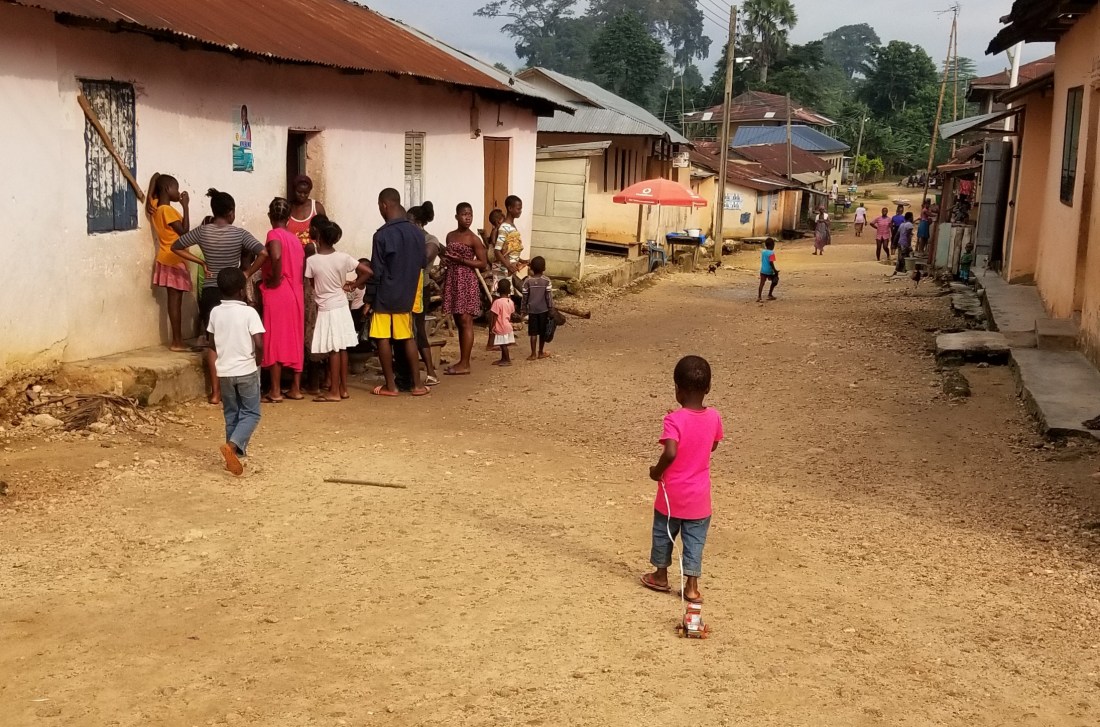
An hour later, she was sitting idly in the grass watching her mother hang the last of the clothes on the line. Buzzing air meandered reluctantly through the clothes and the trees, already stagnating under the hot highly climbing sun. Far-off sounds of the waking town drifted into the house and yard. Knowing they would be going soon to her mother’s shop, Maduwa had slipped on her sandals and brought her small wheeled toy to within arm’s reach.
At a signal from her mother, she raised herself, grabbed her toy by its white ribbon, and started off after her mother up the worn path.
There were always lots of interesting things on the path to town. Along the right side, the brown skittering lizards darted this way and that, making a ch-ch-ch-ch sound through the piles of dead plantain leaves and plastic bags. Further up, there was a patch of exposed rocks and pebbles which always had one or two snail shells hidden among them. Maybe today there would be another line of ants marching determinedly head-to-abdomen like she’d seen last week. Maybe that puddle at the top of the path would have that little family of ducks again. She meandered in bursts from one curiosity to another, every minute pausing with downcast wonder until she remembered she needed to keep pace with her mother, who plodded on firmly around rocks and mud puddles. The wooden wheeled toy trundled and tumbled along behind, dismayed at the white ribbon yanking it ahead.
Passing neighbors’ tree-nestled houses and streams of air laden with the scent of drying cocoa beans, they emerged finally into a clearing with the schoolhouse on one side and the tall steepled church on the other. The girl stood and stared with liquid eyes at the long schoolhouse with its numerous doorways and windows and porch columns. The big kids in blue and white uniforms congregated slowly upon it from all over town, sweeping its rooms, shrieking up and down its porches, wielding cutlasses on the tall grass surrounding it. What an exciting place, what a scary place. She was torn by a longing to be grown up like the kids across the field, and yet didn’t want to leave the quiet and calm she’d always known. With a sigh, she skipped ahead to the roadside where her mother had cast a quick glance backwards.
The dirt road plunged between wood and plaster shacks and houses. In pinks and blues of chipping paint, in dull browns and grays of old wood, in steely brightness and deep burnt reds of rusting tin roofs, the town spread outward from its rocky sloping road. Standing in doorways overlooking it, walking across and up and down it, dealing and squatting and haggling and wandering throughout it, the town’s people and animals moved among and about on the brown-red artery. Shopkeepers, schoolchildren, dogs, old women balancing baskets, old men playing checkers, a line of goats with nervous dark eyes, a preacher with a megaphone – they called and chittered and cried out in the sharp dust, sunlight, metal, rocks, droppings.
Her mother had made her way deftly around standing crowds and stalls until she was out of view, but Maduwa knew the way to her mother’s shop, and so kept plodding on with her wooden toy in ponderous tow. She smiled shyly at the men playing checkers, looked wide-eyed at the group of young adults talking passionately, dodged clumsily around the couple of goats crossing the road with mild panic. Finally, up ahead she saw her mother stopped and unlocking the door of a storefront. She trotted the rest of the way for a reason she didn’t know.
Half an hour later, seated on a small stool next her standing mother, she ate slowly from a bowl of fried yams. Young girls and old men passed with staccato laughs and gravelly greetings. A creaky car grumbled past, crunching its way down the road around potholes and chickens. The preacher paused his proclamations to address a technical difficulty with his megaphone. And she, her stomach full and the breeze wisping coolly across her face, felt her eyelids heavy.

 Tim in Ghana: A Look into the Life of a Peace Corps Volunteer