Saturday, 9 June 2018
Clay
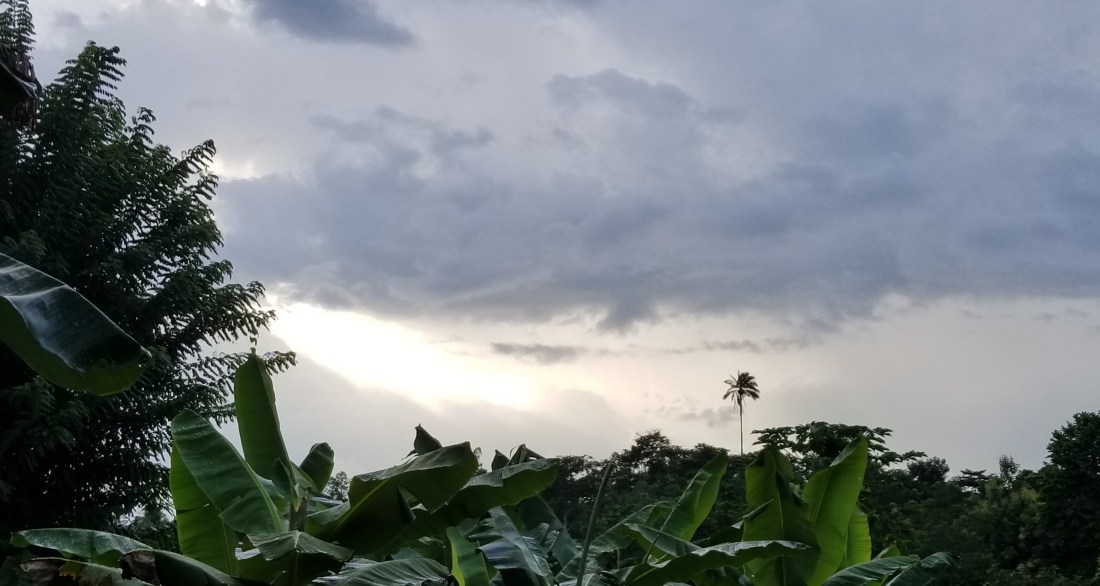
Flying low over the treetops of far outer Accra, I gazed out the window at the landscape pouring slowly by. Below me were dark green tree leaves in thinning and clumping groups, cut through by clay-red lines of straight bumpy roads. Occasionally a collection of houses and shacks gasped out of a road intersection, its fingers of houses and people grasping for purchase despite the ever-pressing growth. Off on the urban horizon the reds and greens faded to grays, browns, and that strange color which when you get closer is a cacophony of flashy bursting advertisement, but from far away just looks like trash.
As we deplaned onto the tarmac, and rode the waiting buses to the terminal, and wandered to baggage claim, and passed through customs, and were greeted by PC staff outside, and stood in the sun for pictures, and rode other buses out of Accra, I missed those city outskirts. Through the chatting and smiling and hand-shaking and sweating, I missed the look of deep leaves and clay roads. It must have been when we’d driven an hour from the airport, and our tires started to redden with the road, that I exhaled and thought that this might be okay after all.
The city is lots of things, but first it is stressful. This has been true for every city I’ve seen, and even more true for the developing cities, where the dust and trash and dilapidated buildings and margin-chasing masses jostle you this way and that, all while the hubbub and honks make you feel like, despite all this, you must keep moving, keep moving. It thins us. I found myself, like those old slime toys that sometimes did and sometimes didn’t stick to the walls, thickening and pulling back together as we drove out of the impact of Accra. On the clay roads I felt the roots of a person slowly growing.
Ghana is a country of many years and many peoples, thrust into a world of the West as jarringly as its trees and tribes were severed by map-drawn borders. The streets of its cities hum with the spirit of fresh history; its citizens, streaming to urban capitals from village huts, bring sharp to the air their salt of the earth. And in that wilder land still there are chiefs and ancestors, libations and prayers, apart from the law, apart from our gods. We judge the tree according to its trunk and branches, and the country according to its city. But let’s remember too the roots – the soul – in that red clay.
Sweating
Have you ever sweat? I mean really, really sweat?
Have you ever walked upright through stifling humidity under the sun of the tropics, in slacks and a button-down? You sweat all the way into the tips of your hair. The salty slick beads fall through your eyebrows and into your eyes, around the nosepiece of your sunglasses, down past the edges of your nose and into the corners of your mouth. It cascades from behind your ears down your neck, filling the collar of your undershirt, seeping in spots to your button-down. From your armpits and the small of your back it rides your tucked shirt to your underwear, and the hot trickle keeps falling, keeps falling. From your belly button to your darkening waistband. From thighs and calves to soggy socks and squishing shoes. You curse your body for sweating so much. You think about how awful you’ll smell, and already smell. You wonder if you have enough clothes for this week, or even for today. And the sun beats down, and the rooms are stuffy, and the breezes are just never strong enough.
Have you ever peeled off sticky clothes for a muggy bedtime? You have to fight with your shirt and your pants until they’re finally inside-out in a pile on the floor, and you have to groan and lean over and pick them up and hang them to dry in the wet air. In the shower, no amount of pouring of buckets over your head cools your radiating skin, and with sweat still pouring down your face you towel off, never really cool, never really dry. Then, already sticky again, you lay on the bed. But the mattress returns the heat to you from below. The thin sheet you pull over yourself is too much. You throw it off. The air hanging over your chest and outstretched legs is far too much. You lay helpless. When you shift, the fitted sheet tries to roll with you. Your pillow is damp, the area below it is wet. The fan, if you’re lucky enough to have it, is feeble and insulting. Maybe it will cool before morning, you think. So you close your eyes and wait for the sunrise.

 Tim in Ghana: A Look into the Life of a Peace Corps Volunteer
Both entries were great reads. I liked the second one better for the description of far away places and how relatable I find sweating :). In response your previous post, I prefer deep dives, always. Will look forward to your next post. Thanks for doing this!
LikeLike
What, a purebred Texan can’t handle the heat (and consequential sweat)? I’d be done for then. What is the humidity like?
Also, repeatedly I had thoughts of our India tripwhile reading through this:
“…where the dust and trash and dilapidated buildings and margin-chasing masses jostle you this way and that, all while the hubbub and honks make you feel like, despite all this, you must keep moving, keep moving.”
Is honking treated the same way, counterintuitive to American standards, as a form of communication (“hey, I’m right here”) instead of an outlash?
LikeLike
It’s not quite as heavily used here as it is in India, but yeah pretty much honking is semi-polite. In fact, India was some good background training for Ghana hahaha.
Dude, it’s all about the humidity. Can’t get away from it. Ughhhh
LikeLike
Tim, one can see the change in your writing from your initial entry. Was it the heat which brings on an unfamiliar fatigue, or was it the many months of anticipation which is now a reality? Whichever you have a knack for embracing the reader. A soon to be well known author in the making? Perhaps. I really need to go shower now. Best!
LikeLike
Tim – You paint such a soulful picture (no surprise). So sorry that you’re suffering, but hopefully adapting will happen sooner than later. I’ll send some Goldbond…! Love you.
Mom
LikeLike
All that sweating is exactly what I go through just vacuuming the house!
LikeLike
I wonder if your last paragraph of “Clay” will change at all after spending more time in a village? For now, it feels… idyllic.
This is lovely language. You like that parallel structure and alliteration. Please write more!
LikeLike
Idyllic, exactly yes! Since part of my job is to introduce Ghanaian culture to Americans, I wanted to write about rural and rural-minded Ghanaians in the way that we write favorably about our own similar class of Americans. To me at least the language used was familiar, even if it wasn’t bulletproof.
LikeLike
Maybe that’s why to had to read it so many times–because it felt familiar but I didn’t expect it to.
LikeLike
Wow Tim! I just found out Sunday that you are in the Peace Corps, in Ghana, and I am so thrilled for you and all whom you will touch. You write really well, and it is so important to do what you are doing, on so many levels, and to help those of us who will probably never be there, “get”a little of it. Thanks!! and keep writing!
LikeLike